Wednesday, June 12, 2019

Poisoning The Well

Handling Rattlesnakes,

So anyway, Pompeo is asked by some ridiculous twat what he’s going to do in the event of a Corbyn-led Kristallnacht, and WaPo reports on his response as follows:
​ ​Pompeo said, “It could be that Mr. Corbyn manages to run the gauntlet and get elected. It’s possible. You should know, we won’t wait for him to do those things to begin to push back. We will do our level best,” he said to fervent applause from attendees.
​ ​“It’s too risky and too important and too hard once it’s already happened,” he said.​..​

​ ​“President Trump and his officials’ attempts to decide who will be Britain’s next prime minister are an entirely unacceptable interference in the UK’s democracy,” The Guardian quotes a Labour spokesperson as saying in response to the revelation.
​ ​“STOP: The Secretary of State Mike Pompeo just promised ‘Jewish leaders’ in the United States that he would stop Jeremy Corbyn coming to power here,” tweeted former British MP George Galloway. “Is this normal now? Is this what we’ve been led to? Is this good for Jews? For Britain? Really?”
​ “They did it in Latin America, Africa and Asia. Now the US government wants to overthrow democracy in Britain,” tweeted The Guardian’s George Monbiot. “Still waiting for a UK government spokesperson to express their outrage. Hello???”
​ ​ “Hmm. Hard to spin this any other way: the US secretary of state secretly promises US Jewish leaders to prevent Corbyn from becoming UK prime minister,” tweeted British journalist Jonathan Cook“Hard too not to suspect that the US is *already* helping to ensure Corbyn doesn’t become PM. Because the obvious implication of Pompeo’s comment is that the US knows it can damage Corbyn without leaving fingerprints at the crime scene — presumably through black ops, image management etc. The elephant in the room: Why assume the US isn’t already using those techniques?”  

​ ​Trump appears unwilling to go down in history as the president responsible for kicking off nuclear Armageddon. But what about the next president? The deep state in control of US politics would surely be able to place into office someone who would advance the final justification for a headlong confrontation with Moscow and Beijing.
​ ​If you think I am exaggerating, take Pompeo, a representative of the deep state, and his recent answer to the question of whether Trump was sent by God to save Israel from Iran. “As a Christian, I certainly believe that’s possible”, he responded.


​If only we could elect Joe Biden president, he would "Cure Cancer"!

​ ​Tulsi’s own military experience notwithstanding, she gives every indication of being honestly anti-war. In the speech announcing her candidacy she pledged “focus on the issue of war and peace” to “end the regime-change wars that have taken far too many lives and undermined our security by strengthening terrorist groups like Al-Qaeda.” She referred to the danger posed by blundering into a possible nuclear war and indicated her dismay over what appears to be a re-emergence of the Cold War.
​ ​In a recent interview with Fox News’s Tucker Carlson, Gabbard doubled down on her anti-war credentials, telling the host that war with Iran would be “devastating,” adding that “I know where this path leads us and I’m concerned because the American people don’t seem to be prepared for how devastating and costly such a war would be...
​ ​Gabbard, and also Carlson, did not hesitate to name names among those pushing for war, one of which begins with B-O-L-T-O-N. She then asked “How does a war with Iran serve the best interest of the American people of the United States? And the fact is it does not,” Gabbard said. “It better serves the interest of people like [Israeli Prime Minister Benjamin] Bibi Netanyahu and Saudi Arabia who are trying to push us into this war with Iran.” ​...​ 

​ ​Tulsi Gabbard had previously called for an end to the “illegal war to overthrow the Syrian government,” also observing that “the war to overthrow Assad is counter-productive because it actually helps ISIS and other Islamic extremists achieve their goal of overthrowing the Syrian government of Assad and taking control of all of Syria – which will simply increase human suffering in the region, exacerbate the refugee crisis, and pose a greater threat to the world.”  ​...
​ Last May, she criticized Israel for shooting “unarmed protesters” in Gaza, a very bold step indeed given the power of the Israel Lobby.​..
​ ​Tulsi Gabbard could well be the only genuine antiwar candidate that might truly be electable in the past fifty years, and that is why the war party is out to get her.

​ ​Two day after a massive, 1+ million protest took place in Hong Kong, with demonstrators demanding the end to a proposal allowing extraditions to China, a follow up protest took place with thousands of people blocking local streets, and Hong Kong police defended the use of tear gas and rubber bullets to control a “riot situation” after protesters tried to storm the chamber where lawmakers were expected to take up - and pass - the controversial bill...
 ​ ​As we noted last night, a repeat protest erupted early on Wednesday, and it only got worse as the day progressed as  demonstrators - many of them clad in goggles, face masks and helmets -fled to different areas, running through plumes of smoke - threw bricks, bottles and umbrellas at riot police guarding the city’s Legislative Council; they dragged metal barriers and linked arms across roads surrounding government headquarters, in scenes reminiscent of the 79-day street protests that paralyzed parts of downtown Hong Kong in 2014...
 So much tear gas was used that commuters waiting at nearby subway stations and people in shopping malls were coughing and tearing up, and many sought medical attention.
​ ​Many of the city’s lawmakers, from both the pro-democracy camp that opposes the contentious extradition legislation at the heart of the protests and the pro-Beijing majority that supports it, failed to arrive at the council for a scheduled debate on Wednesday morning, after protesters surrounded the complex and blocked traffic.
​ ​Some financial services were also disrupted. HSBC Holdings PLC closed two banking-service outlets in the Admiralty area until further notice, while other banks including Standard Chartered PLC, Bank of East Asia Ltd. and China Citic Bank Corp. temporarily suspended operations at branches near the protest area.
​ ​Even though the opposition bloc in the city’s legislature has been weakened after authorities ousted several democratically elected lawmakers through court orders and barred others from running, opposition to the proposed law came from many corners of society, including businesspeople, lawyers and activists, who say the changes would undermine Hong Kong’s relative autonomy and independent judicial system...
​ ​“The government needs to acknowledge that my voice matters,” said Candy Wong, a 27-year-old shop assistant who said she was angered after authorities pressed ahead with the bill even after more than a million people—including herself—took to the streets in protest. Ms. Wong took a day off to join the rally. “If I didn’t come today by next week I may no longer have the freedom to do so.”

 
​Dan sends this well researched and written "long read" on how the opioid epidemic came to nest in Appalachia.​
​ ​In chemical terms, carfentanyl is as mortal a threat as nerve gas – more poisonous by median lethal dose (one nanogram) than the venom of the Mojave rattlesnake. It was once unregulated, but after containing its production, the Chinese government made a pointed statement:
​ ​America consumes 80 per cent of the world’s opioids. 2. China, a country in which these substances could be purchased online at wholesale prices, does not have an opioid problem. 3. If America has an opioid problem, it is not because of pharmaceutical imports but American-manufactured prescription drugs.
​ ​All true. At the heart of this domestic consumption is the region of Appalachia, set in mountainous seclusion between Kentucky, Virginia, Pennsylvania and West Virginia. Appalachia, when it is thought of at all, occupies a kind of ‘herrre be dragyns’ place on the American mind map of most Americans, occupied by doodled stereotypes: coal, hillbillies, Deliverance playing on repeat. Opioid addicts were just added to the stereotypes, a single letter changed to neologize them as ‘pillbillies’...
​ ​Pastor M. told me about an early Pentecostal missionary, a barely tolerated presence in some mining camp full of hard men. They ignored him, and let him know he was ignored, until one day the whole camp arrived en masse to his tent, bending the brims of their hats in their hands, asking to join his ‘congregation’.
​ ​‘May I ask,’ said the missionary, ‘what made you change your minds?’
​ ​‘Well,’ said their leader, ‘we have been poisoning the water in your well, and as you are unaffected, we figure you must have something to teach us.’

​Being Persistent​

Sunday, June 9, 2019

Green Old Deal

Not Born Yesterday,

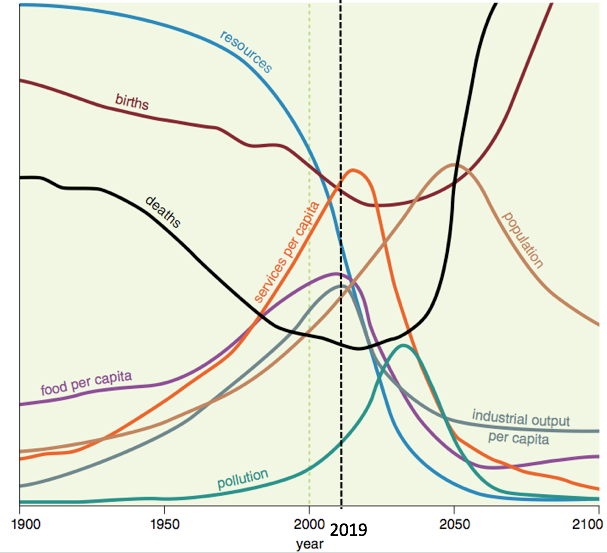
​I'm going to start with the conclusion, which is that actual productive economic growth has already ended, and we are keeping the complex system coherent by using fake financial "growth", which can seem to work, until it doesn't. I think the dateline "2019" on the graph below should be 2-3 mm to the right. People keep changing the year on that same line. The real economy is rolling over.
 The article on "degrowth" caught my interest, but it sounds like it was written by city people who are stressed out by paychecks that don't keep up with shopping, and see a life with less shopping, less pay, city buses, and free education and medical care as being simpler, with more leisure time. 
  It does not seem that the author has had to solve existential problems, grow food, or make useful necessities, like clothing or furniture.
The life with more leisure time was easier to believe in the 1960s, when there was more of everything for everybody every year.
This is the simpler, easier life we are living now, which is why so much of the world wants to get in where there is plenty of food, cars, public services and clean water..  
 I'll put in a piece Eleni sent from Jim Kunstler about where some of us might get to some day, without some of the others.
 Gail Tverberg's article, sent by Charles, along with the one about high tech can't last (really limited existence on the planet of rare-earth elements, which are completely critical to the screen I'm looking at and everything that precedes it).
 There's more about the trade wars from other perspectives, but Gail's perspective is paramount, directly related to global energy limits and the effects that expensive energy is having on the global economic web. She doesn't mention the US policy of bombing all the oil countries that start selling oil for anything other than dollars. That moves their oil into the future, by destroying their ability to pump and burn it now.  
 The latest analysis, still showing the financing of the shale oil miracle to be a lot like the housing bubble is included. Shale oil is useful as a US weapon on the global stage, increasing the power of the Petrobuck-Empire to bomb and blockade oil-producing non-vassals, while keeping tribute-paying vassals in Europe and Japan from economic collapse.
Charles' own essay about a rural revival follows that, and one I have sent before, about the rural creative class.
 Creativity and manufacturing going rural is important, because what is happening in the cities is compliance economy, with creativity fading away, too risky. To afford a creative project, one has to be where rents are lower, code-compliance less daunting, and expectations of workers less tightly scripted and defined.
​ The article that packed the most punch for me was the one about the very limited supplies of rare-earth elements on our fair planet. 
There is not enough to keep making laptops, smartphones, video screens, hard drives, microchips, electric car and wind turbine magnets and so on. Some of these very hard limits have already been brushed a few times, but the global trade war (best kind of war, I think) is likely to make them acute. The majority of these come from China, because that's where most of them are. China has few enough cards to play in a trade war. China will probably stop exporting these, except in manufactured products. 
I suspect there is already a lot of quiet coercion going on. Apple has to make iPhones in China, right?​
 
​Imagine an almost infinite celestial fruit-​cobbler...
 In 1972, a team at MIT published The Limits to Growth, a report that predicted what would happen to human civilization as the economy and population continued to grow. What their computer simulation found was pretty straightforward: On a planet of finite resources, infinite exponential growth isn’t possible. Eventually, non-renewable resources, like oil, would run out.
Historically, we have considered growth a positive thing, synonymous with job security and prosperity. Since World War II, the gross domestic product (GDP) measure has been used as “the ultimate measure of a country’s overall welfare.” ...
But growth has led to other problems, such as the warming of the planet due to carbon emissions, and the extreme weather and loss of biodiversity and agriculture that comes along with that. Consequently some activists, researchers, and policy makers are questioning the dogma of growth as good. This skepticism has led to the degrowth movement, which says the growth of the economy is inextricably tied to an increase in carbon emissions. It calls for a dramatic reduction in energy and material use, which would inevitably shrink GDP.
The Green New Deal, popularized by Alexandria Ocasio-Cortez, seeks to decrease carbon by growing the renewable energy industry. But the degrowth movement believes we need to take this further, by designing a social upheaval that disentangles the idea of progress and economic growth once and for all. This new accounting of economic success would instead focus on access to public services, a shorter work week, and an increase in leisure time. Their approach, they say, will not only combat climate change, but free us from a workaholic culture in which so many struggle to make ends meet...
 This is how degrowthers envision the process: After a reduction in material and energy consumption, which will constrict the economy, there should also be a redistribution of existing wealth, and a transition from a materialistic society to one in which the values are based on simpler lifestyles and unpaid work and activities...
 People can try to live a degrowth-esque lifestyle today by buying fewer things, but ultimately it's challenging to commit to degrowth without those public services that are built into the model...
 Since there are so few real-world examples of degrowth, Kallis has used a fictional utopia to explain the concept in a 2015 paper...
“It’s how we imagine the good life,” Kallis said. “A life that is simpler, not a life where we keep producing more and more running faster and faster, and having more and more products to choose from.”


​Eleni sent this from Kunstler:  Going Where, Exactly?
​ ​Well, we’d better adjust our thinking to the fact that the horn-of-plenty is shockingly out of goodies, and that no amount of financial hocus-pocus is going to refill it. Valiant attempts to redistribute the already-existing wealth are liable to prove disappointing, especially when the paper and digital representations of that wealth in “money” turn out to be figments — promises to pay that will never be kept because they can’t be kept.
 ​So, instead of fantasizing about free PhD programs for everybody, and free insulin for the multitudes, consider instead the vista of a reduced population working in the fields and pastures to bring enough food out of the long-abused land to live through the next winter. Consider a world in which, if we are lucky, the electricity runs for a few hours a day, but possibly not at all. Imagine a world in which men and women actually function in different divisions of labor and different social spaces because they must, to keep the human project going. Imagine a world in which the ideas in your head about that world actually have to comport with the way the way that world really works — and the severe penalty for failing to recognize that.

​ ​Nearly everyone wonders, “Why is Donald Trump crazy enough to impose tariffs on imports from other countries? How could this possibly make sense?”
​ ​As long as the world economy is growing rapidly, it makes sense for countries to cooperate with each other. With the use of cooperation, scarce resources can become part of supply lines that allow the production of complex goods, such as computers, requiring materials from around the world
The downsides of cooperation include:
(a) The use of more oil to transport goods around the world;
(b) The more rapid exhaustion of resources of all kinds around the world; and
(c) Growing wage disparity as workers from high-wage countries compete more directly with workers from low-wages countries.
​ ​These issues can be tolerated as long as the world economy is growing fast enough. As the saying goes, “A rising tide lifts all boats.”
​ ​In this post, I will explain what is going wrong and how Donald Trump’s actions fit in with the situation we are facing. Strangely enough, there is a physics aspect to what is happening, even though it is likely that Donald Trump and the voters who elected him would probably not recognize this. In fact, the world economy seems to be on the cusp of a shrinking-back event, with or without the tariffs. Adding tariffs is an indirect way of allowing the US to obtain a better position in the new, shrunken economy, if this is really possible.

​ ​Yet another downturn could not come at a worse time for U.S. shale drillers, who have struggled to turn a profit. Time and again, shale executives have promised that profitability is right around the corner. Years of budget-busting drilling has succeeded in bringing a tidal wave of oil online, but a corresponding wave of profits has never materialized.
​ ​Heading into 2019, the industry promised to stake out a renewed focus on capital discipline and shareholder returns. But that vow is now in danger of becoming yet another in a long line of unmet goals.
​ ​“Another quarter, another gusher of red ink.”

High Tech Can't Last; There Are Limited Essential Elements:
​ ​This long post describes the rare metals and minerals phones, laptops, cars, microchips, and other essential high-tech products civilization depends on.
​ Metals and minerals aren’t just physically limited, they can be economically limited by a financial collapse, which dries up credit and the ability to borrow for new projects to mine and crush ores. Economic collapse drives companies and even nations out of business, disrupting supply chains.
​ ​Supply chains can also be disrupted by energy shortages and natural disasters. The more complex, the more minerals, metals, and other materials, machines, chemicals, a product depends on, the greater the odds of disruption.
​ ​Minerals and metals can also be politically limited.  China controls over 90% of some critical elements.
​ ​And of course, they’re energetically limited.  Once oil begins to decline, so too will mining and all other manufacturing steps, which all depend on fossil energy.
​ ​The next war over resources is likely to be done via cyber-attacks that take down an opponent’s electric grid, which would affect nearly all of the other essential infrastructure such as agriculture; defense; energy; healthcare, banking, finance; drinking water and water treatment systems; commercial facilities; dams; emergency services; nuclear reactors, information technology; communications; postal and shipping; transportation and systems; government facilities; and critical manufacturing (NIPP)

 
What Would It Take to Spark a Rural/Small-Town Revival?​   Charles Hugh Smith
The decline of rural regions and small towns is a global phenomenon, and the causes are many but boil down to two primary dynamics:
1. Cities and megalopolises (aggregations of cities, suburbs and exurbs) attract capital, infrastructure, markets and talent, and these are the engines of job creation. People move to cities to find jobs...
2. Globalization has lowered the cost of agricultural commodities by exposing every locality to globally set prices (supply and demand).
​T​he relatively low cost of fuels has enabled produce from thousands of miles away to be shipped to supermarkets virtually everywhere.
These mega-trends have slashed farming incomes while costs have risen across the board. This squeeze as revenues decline and costs increase has driven even the most diligent and devoted farmers out of business...
Recent research supports the idea that this under-the-radar migration is already under way. The Rise of the Rural Creative Class (via Kevin M.) A growing body of research shows that innovative businesses are common in rural areas, and rural innovation gets a boost from the arts.
A series of studies from Tim Wojan and his colleagues at the U.S. Department of Agriculture’s Economic Research Service documents the drivers of rural innovation. Their findings draw on a variety of data sets, including a large-scale survey that compares innovation in urban and rural areas called the Rural Establishment Innovation Survey (REIS). This is based on some 11,000 business establishments with at least five paid employees in tradable industries—that is, sectors that produce goods and services that are or could be traded internationally—in rural (or non-metro) and urban (metro) areas.

​ The ​U.S. Department of Agriculture’s Economic Research Service documents the drivers of rural innovation. Their findings draw on a variety of data sets, including a large-scale survey that compares innovation in urban and rural areas called the Rural Establishment Innovation Survey (REIS). This is based on some 11,000 business establishments with at least five paid employees in tradable industries—that is, sectors that produce goods and services that are or could be traded internationally—in rural (or non-metro) and urban (metro) areas.
​ ​The survey divides businesses into three main groups. Roughly 30 percent of firms are substantive innovators, launching new products and services, making data-driven decisions, and creating intellectual property worth protecting...  

​ ​Wojan and company’s analysis find a strong statistical association between the arts, innovation, and economic dynamism in rural areas. And this leads them to conclude that the arts are a direct force in rural innovation, not just an indirect factor that helps to attract and retain talent.
https://getpocket.com/explore/item/the-rise-of-the-rural-creative-class

The West's "Manufacturing War With Russia", useful context and perspective from Eleni.
​ ​In October 1993 Yeltsin, after dissolving the parliament, ordered army tanks to shell the Russian parliament building, which was being occupied by democratic protesters. The assault left 2,000 dead. Yet during his presidency Yeltsin was effusively praised and supported by Washington. This included U.S. support for a $10.2 billion International Monetary Fund loan to Russia during his 1996 re-election campaign. The loan enabled the Yeltsin government to pay huge sums in back wages and pensions to millions of Russians, with checks often arriving on the eve of the election. Also, an estimated $1.5 billion from the loan was used to directly fund the Yeltsin presidential campaign. But by the time Yeltsin was forced out of office in December 1999 his approval rating had sunk to 2%. Washington, losing Yeltsin, went in search of another malleable Russian leader and, at first, thought it had found one in Putin. ​“Putin went to Texas,” Cohen said. “He had a barbecue with Bush, second Bush. Bush said he ‘looked into his eyes and saw a good soul.’ There was this honeymoon. Why did they turn against Putin? He turned out not to be Yeltsin. We have a very interesting comment about this from Nicholas Kristof, the New York Times columnist, who wrote, I think in 2003, that his own disillusion with Putin was that he had turned out not to be ‘a sober Yeltsin.’ What Washington was hoping for was a submissive, supplicant, post-Soviet Russian leader, but one who was younger, healthier and not a drinker. They thought they had that in Putin. Yeltsin had put Putin in power, or at least the people around Yeltsin did.”
​ ​“When Putin began talking about Russia’s sovereignty, Russia’s independent course in world affairs, they’re aghast,” Cohen said of the Washington elites. “This is not what they expected. Since then, my own thinking is we were pretty lucky after the 1990s to get Putin because there were worst contenders in the wings. I knew some of them. I don’t want to name names. But some of these guys were really harsh people. Putin was kind of the right person for the right time, both for Russia and for Russian world affairs.”

More on the Multipola-world-power-contest from Eleni.
​ ​“It only happens when both countries are going into war. Cutting off oil supplies to China to some extent is equal to a declaration of war,” Beveridge told Bloomberg.
​ ​China, however, appears to be filling in its strategic petroleum reserves in recent months, as it has been boosting oil imports by 10 percent while refining output has been growing at 5 percent, according to the analyst... over the past few months China has also only sporadically bought crude oil and liquefied natural gas (LNG) from the United States—a sharp reversal from the booming Chinese imports of American energy at this time last year. There were even some months where China purchased no U.S. crude oil at all, according to EIA data. It has also drastically reduced LNG imports from the U.S. as China has a 10-percent import tariff on American LNG—a tariff set to rise to 25 percent on June 1.
​ ​With the trade war heating up, China appears to be rallying all means and resources available to reduce the role of the U.S. in its economy and economic growth, as Beijing has lost trust in the United States both as a supplier and an export market, Jefferies Group’s Yu told Bloomberg.  

 
Those forever-chemicals in our food are not inert. They keep working their magic "forever". 
The cat got out of the bag early.
​ ​The Food and Drug Administration (FDA) has quietly revealed some troubling information about a class of toxic chemicals that the agency found in significant levels in our food supply.
​ ​At a recent scientific conference, the FDA shared the findings of its first broad testing of food for a worrisome class of nonstick, stain-resistant industrial compounds called per- and polyfluoroalykyl substances, or PFAS.
​ ​The FDA has not made its findings public yet, but agency researchers discussed the results at a conference held by the Society of Environmental Toxicology and Chemistry last week in Finland. The Environmental Defense Fund and the Environmental Working Group obtained the FDA presentation and provided it to The Associated Press.
​ ​Substantial levels of PFAS were found in grocery store meats and seafood and in off-the-shelf chocolate cake:
​ ​The levels in nearly half of the meat and fish tested were two or more times over the only currently existing federal advisory level for any kind of the widely used manmade compounds, which are called per- and polyfluoroalykyl substances, or PFAS.​..

There is evidence that exposure to PFAS can lead to serious adverse human health effects, including cancer, reproductive harm, developmental harm, high cholesterol, damage to the immune system, hormone disruption, weight gain in children and dieting adults, and liver and kidney damage.

Children Also Affected

Thursday, June 6, 2019

Look At This

Inspectors,

It may seem odd that I am putting an article about MMT, Modern Monetary Theory at the top of the stack, but it is not a "thing" in itself. 
It is a lens through which one may see the workings of power in a country/society, and what choices the society makes, and what the limits to those choices actually are. This is a discussion we are entering, out of necessity, yet again...
​ ​Finally, despite showing that currency-issuing governments don’t face a financial constraint, MMT doesn’t claim that a nation faces no spending constraints whatsoever; rather, it shows that the real constraints faced by governments are the real resources (plants, machines, workers, etc.) available to the nation either locally or through trade. It follows that the real limit to government spending is the capacity of the economy to absorb it without generating runaway inflation...
 In fact, MMT is not a regime that you ‘apply’ or ‘switch to’ or ‘introduce’. Rather, it is a lens which allows us to see how our fiat monetary systems already work. How you decide to use that understanding depends on the value system or ideology you apply to it. It thus makes little sense to talk of ‘MMT-type prescription’ or an ‘MMT solution’. Indeed, governments already operate according to the framework offered by MMT, regardless of what they may claim in public (and the accounting smokescreens they may employ).
​ ​Citizens are constantly told that the government cannot afford to invest more in education, healthcare, infrastructure, welfare and other public services. Yet, there is never a lack of money when it comes tax cuts for the rich, bank bailouts, military activities and other programmes that benefit our political and economic elites. As of March 2006, approximately £4.5 billion had been spent by the UK in Iraq, enough to pay for the building of around 44 new hospitals and to fund the recruitment and retention of over 10,300 new teachers for ten years. Yet, there was never any debate about how the UK would ‘fund’ the war.​..

 But if there is a need to attenuate spending growth in the economy, MMT demonstrates the superiority of an employment buffer stock approach–the Job Guarantee–over the current unemployment buffer stock approach to inflation control. Instead of creating unemployment to discipline wage demands, MMT proponents advocate that the government would, instead, offer a public sector job at a socially- inclusive minimum wage to anyone who seeks to work. Redistributing labour from the inflating sector to the fixed price sector would ensure price stability and avoid costly mass unemployment.​..
 In the presence of an external deficit, the government will have to run a fiscal deficit to maintain spending sufficient to keep all resources fully employed. Since Britain has run an external deficit since the 1970s, and is not likely to generate large external surpluses in the foreseeable future, it follows that the only way private debt–and the power of financial institutions over society–can be brought under control without driving the economy into recession is for the government to run persistent and substantial fiscal deficits.​..
 The support of mainstream economists and financial operators for certain theories and policies doesn’t stem from a sincere belief in their virtue, but from the fact that they promote the interests of the dominant forces in society. The idea that a socialist government could guarantee itself the support of the economic establishment simply by adhering to the ideological framework that its members claim to believe in, with the aim of deploying mainstream theories and policies for progressive ends, is naïve.
​ ​Moreover, Meadway neglects the fact that the power of the capitalist establishment derives as much from its command of the state and means of production as it does from its capacity to frame the narrative. The primacy of these fiscal rules is a key part of the way in which the economic establishment censures governments that might be intent on redistributing national income or improving welfare services and the like.
 Ultimately, the ideology of scarcity of money is integral to the maintenance of our deeply unequal relations of power in society. If there’s anything the establishment fears more than the working classes seizing the means of production, it’s the working classes seizing the means of production of money (or more precisely, of currency)​..​
  MMT gives us the power to imagine truly transformational politics, without getting caught up in meaningless debates about whether we can ‘afford’ it or not. This is also why it is being attacked so fiercely. Not because of its theoretical foundations, but because of the range of economic and political possibilities that it opens up. The bottom line, however, is that MMT is here to stay.  

​These mules can't pull the economic wagon, and they are giving up.
The net worth of millennials (18- to 35-year-old) has collapsed 34% since 1996, according to a new, shocking report from Deloitte.
 Millennials are financially worse off than any other generation before them. With student loans, auto and credit card debts, rising rents, and out of control, health-care costs have pushed their average net worth below $8,000.
https://www.zerohedge.com/news/2019-06-02/millennial-net-wealth-collapses-study-finds  

​The current monetarist capitalist framework pumps "money" into anything that can hold it, which amplifies the current system of wealth-distribution. The rich get richer and the poor get poorer. This has become a very sick structure, and these sick structures ultimately collapse, because of reality.​ When the structure collapses, nobody is rich, because the economy does not function. This is monetarist analysis...
Hey, look! It ends up in the same place.
​  ​Rickards: Going back to the 1929-1937 period, the old rule was to prick bubbles to relieve speculative pressures. But, this ended up causing recessions rather than preventing them. By the 1998 - 2001 period, the conventional wisdom was to let bubbles run their course and then clean up the mess afterwards.  But the Fed has failed to distinguish between credit driven bubbles and mania driven bubbles.  The former are dangerous because they are connected with the credit system, the latter less so because people loose money but the crisis is not systemic. The 2000 dot.com bubble was speculative, but not credit driven so it did not turn into a systemic crisis when it popped.  Of course 2008 was credit driven and it did metastasize throughout the system right up to the top of the food chain with large banks and the housing GSEs failing.  When you are kicking around the idea of should I or should I not pop the bubble, this is a key distinction and the threshold question for policy. You should pop or defuse credit driven bubbles, but perhaps let speculative bubbles (most recently Bitcoin) run their course. The problem is that Fed policymakers do not seem to grasp this fundamental distinction. This leads to credit bubbles being allowed to spin out of control into systemic crises.​..
 Rickards: That is a profound question you raise about the impact of monetary policy on visible credit metrics. The answer very simply is that you can’t get out. It's one thing when loose monetary policy results in private credit extremes. The Fed can reign that in. But, what happens when public credit from the Fed is the source of the problem?  The Bernanke choice of stoking asset price inflation via zero rates and QE is not something that can be reversed without a great deal of pain.  Once you make that trade-off between promoting inflation and future market instability, you have no way out.  You’re much better off taking the pain and accepting a lower level of economic growth in the short-run rather than deferring the pain but creating far larger asset bubbles down the road.  There is no way out of the Bernanke policy choice without bigger bubbles and much larger market crash that results.  This is why I believe that we face a financial market crash as bad or worse than 1929 or 2008.​..
​  Rickards:  When all of the solutions from Washington and all of the big ideas about economic growth fail, then we may need to fall back on a community based, semi-agrarian model that resembles austerity in today’s terms. Such a model is far more stable than the radical boom and bust model of Greenspan and Bernanke. 
​  ​Rickards:  We need to move beyond ideology and towards a more pragmatic discussion about how we measure and describe growth. Let’s do what works.  

​Pepe Escobar covers (leaked rumors of) the recent Biderberg meeting of 130(ish) global power elites in Switzerland.
The major issue discussed this year was “A Stable Strategic Order”, a lofty endeavor that can be interpreted either as the making of a New World Order or just a benign effort by selfless elites to guide mankind to enlightenment...
The Greens who won in Europe – contrary to the US Greens – are all humanitarian imperialists, to quote the splendid neologism coined by Belgian physicist Jean Bricmont. And they all pray on the politically correct altar. What matters, from Bilderberg’s perspective, is that the European Parliament will continue to be run by a pseudo-Left that keeps defending the destruction of the nation-state.
Just like Castries and his pupil Macron.
 The great Bilderberg secret of 2019 had to do with why, suddenly, the Trump administration has decided that it wants to talk to Iran “with no preconditions”.
It all has to do with the Strait of Hormuz. Blocking the Strait could cut off oil and gas from Iraq, Kuwait, Bahrain, Qatar and Iran – 20% of the world’s oil...
  An American source said a series of studies hit President Trump’s desk and caused panic in Washington. These showed that in the case of the Strait of Hormuz being shut down, whatever the reason, Iran has the power to hammer the world financial system, by causing global trade in derivatives to be blown apart...
 Tehran has not voiced this “nuclear option” openly. And yet General Qasem Soleimani, head of the Iranian Revolutionary Guards Corps’ Quds Force and a Pentagon bête noire, evoked it in internal Iranian discussions. The information was duly circulated to France, Britain and Germany, the EU-3 members of the Iran nuclear deal (or Joint Comprehensive Plan of Action), also causing a panic.
 Oil derivative specialists know well that if the flow of energy in the Gulf is blocked it could lead to the price of oil reaching $200 a barrel, or much higher over an extended period. Crashing the derivatives market would create an unprecedented global depression...
 And that brings us to Secretary of State Mike Pompeo’s long, non-scheduled stop in Switzerland, on the Bilderberg’s fringes, just because he’s a “big cheese and chocolate fan”...
 After weeks of ominous threats to Iran, the US said “no preconditions” would be set on talks with Tehran, and this was issued from Swiss soil...
 Henry Kissinger was a 2019 Bilderberg participant. Rumors that he spent all his time breathlessly plugging his “reverse Nixon” – seduce Russia to contain China – may be vastly overstated. 
 

 Long-term, intense economic competition between China and the United States is inevitable. It’s simply a result of China’s new economic size. It’s about wealth and power, not political systems or ideology. Forget these two countries per se.

​Russia is acutely aware of the international power structure, and has always been wary of her huge neighbor, China, but Russia does what she must do each day... [I believe Russia's long term interests align with the US, but not global elites running our show.]
Just one month after conducting joint military exercises, Russia and China are set to sign an agreement which would boost the use of their national currencies in bilateral and international trade in an attempt to move away from the current dollar-denominated financial system, according to Russian state-owned news outlet TASS.

​Chinese traditional farming is extremely sophisticated. It allowed China to have an empire for 5000 years. Those farmers have been pulled out to work in factories and pour concrete, a one-time extraction of human wealth. The US already spent it's farmers long ago. Global Food War:
Beijing warns US farmers may lose China market for good, but plays down tariffs impact at home
Han Jun, vice-minister of agriculture and rural affairs, says Chinese farmers can export products to non-US markets to weather impact of trade war
Country will also be able to source enough soybeans to meet domestic demand
Farmers in the United States cannot afford to lose the Chinese market, but farmers in China will be able to withstand the impact of American tariffs, according to a top agriculture official in Beijing.
https://www.scmp.com/economy/china-economy/article/3012779/beijing-warns-us-farmers-may-lose-china-market-good-plays

​US farm output will be hugely down this year, and US farmers will need a lot of help, anyway. 
Loss of exports to China to feed pigs may not hurt the American factory-agricultural sector​ much this year.
 According to the latest May 20 report of the National Agricultural Statistics Service (NASS) of the US Department of Agriculture, corn and soybean crops are well behind the planting growth levels normal this time of the planting season. They report that only 49% of all planned corn acreage in the US has been planted compared with 78% at this time a year ago. Of that only 19% has yet emerged from the ground compared to 47% in May 2018. In terms of soybeans, barely 19% of crops have yet been planted compared with 53% a year before. Rice acreage planted is down to 73% compared to 92% a year ago in the six US rice-growing states. Of course, should weather dramatically improve the final harvest numbers could improve. It is simply too early to predict.
 The USA is by a wide margin the world largest soybean producer with 34 percent of the world’s soybean production and 42% of world exports prior to the China trade battles. The US is also the world largest corn or maize producer, almost double China, the number two. A serious harvest failure in these two crops could significantly affect world food prices, leaving aside the unfortunate fact that almost all US soybeans and corn are GMO crops. They are mainly used in animal feed.

Donald Trump Is The most Honest US President Of All Time, Caitlin Johnstone:​
 To be clear, I am not saying that Trump actually tells the truth with his words; he obviously does not. Trump is so comfortable with lying that he once tweeted the claim that he’d never urged House Republicans to vote for a particular immigration bill, three days after posting a tweet explicitly urging House Republicans to vote for that bill. He left both tweets up. I mean, that’s like one click away from literally looking someone in the eye while urinating on their leg and telling them it must be the rain.
 No, when I say that Trump is the most honest US president of all time, what I mean is that he has a unique gift for exposing the face of the empire for exactly what it is, in all its depravity, all its deceitfulness, all its corruption, and in this case, all its jaw-dropping ridiculousness. I mean, look at this photo:
​ ​Obama could have made this look normal. Bush would have looked a little bit goofy, but nothing that would make you spit your coffee on your screen. Hell, Bill Clinton would have looked downright at home, like he was born in Buckingham Palace and spent his whole life sipping champagne and groping the maids while he waited for this photo to be taken. It took the badly-dressed awkward posture and golf bod of a reality TV star who became president via 4chan prank to expose that whole absurd royalty display for the risible self-parody that it deserves to be seen as...
​ ​His whole cabinet is basically human versions of the departments they represent. His Secretary Treasurer was a Goldman Sachs executive. His CIA Director literally tortured people. His National Security Advisor is an Iraq-raping Bush-era neocon. His Secretary of Commerce is a former Rothschild executive. His EPA Administrator is a former coal lobbyist. His Secretary of State came straight out of the CIA. It’s like he designed a convenient labeling system for everyone who’s unsure of what it is that each department in the executive branch of the US government actually does.
 

Kushner: Palestinians not yet capable of governing themselves
​I am certain that Senator Elizabeth Warren understands Modern Monetary Theory (which does not mean that she groks everything.).​
​ ​Warren’s latest plan is in a class by itself, even for Warren. She calls it an Agenda for Economic Patriotism.
​ ​Warren’s proposal does nothing less than turn inside out the globalist assumptions pursued by the past several administrations, Democrat and Republican alike. Where they have pursued more globalization of commerce as an end in itself (and as a profit center for U.S.-based multinational corporations and banks), Warren’s goal is to bring production and good jobs home.
​ ​Even better, she knits it all together with a coherent plan, beginning with a new Department of Economic Development “with the sole responsibility to create and defend quality, sustainable American jobs.”​ ...
​ Even better(er)​, Warren shows up Donald Trump on the question of trade. While Trump’s version of economic nationalism is all swagger, symbol, and shotgun retaliation. Warren’s would actually deliver tangible benefits for the voters who turned in desperation to Trump. By contrast, Trump’s version delivers nothing.

Those packing peanuts made of rice are edible. Rats can live in a box with them for a long time. Can we employ that knowledge somehow?
​ ​The average person eats at least 50,000 particles of microplastic a year and breathes in a similar quantity, according to the first study to estimate human ingestion of plastic pollution.
​ ​The true number is likely to be many times higher, as only a small number of foods and drinks have been analysed for plastic contamination. The scientists reported that drinking a lot of bottled water drastically increased the particles consumed.

​Bean Counter​

Wednesday, June 5, 2019

War On Reality

Leaning on Nothing,

James Kunstler:
Guess what: the global economy is winding down, and pretty rapidly. Trade wars are the most obvious symptom. The tensions underlying that spring from human population overshoot with its punishing externalities, resource depletion, and the perversities of money in accelerated motion, generating friction and heat. They also come from the fact that techno-industrialism was a story with a beginning, a middle, and an end — and we’re closer to the end than we are to the middle. There will be no going back to the prior party, whatever way we pretend to negotiate our way around or through these quandaries.
The USA-China romance was bound to end in divorce, which Mr. Trump is surreptitiously suing for now under the guise of a negotiated trade rebalancing. The US has got a chronic financial disease known as Triffin’s Dilemma, a set of disorders endemic to any world reserve currency. The disease initially expressed itself in President Nixon’s ditching the US dollar’s gold backing in 1971. By then, the world had noticed the dollar’s declining value trend-line, and threatened to drain Fort Knox to counter the effects of holding those dollars. Since then, all world currencies have been based on nothing but the idea that national economies would forever and always pump out more wealth.
 It turns out that they pump out more debt in the pursuit of that chimerical wealth until the economic viziers and banking poohbahs begin to declare that debt itself is wealth — and now all the major players around the world are choking to death on that debt, especially the USA and China, but also Japan and the dolorous commune known as the EU. Everybody’s broke, one way or another, even though they are up to their eyeballs in products designed to fall apart in a few years.


Daisy Luther, The Organic Prepper:
When I was in Bosnia recently with Selco, I was in awe of the fact that they don’t have warning labels, guard rails, or any other protective things keeping stupid people alive. He got a good laugh from my shock over the fact that a scenic lookout had no railing to keep people from plunging to their deaths...
 People have become so dependent on their navigation systems that reading a physical, honest-to-goodness-piece-of-paper map has become a lost art.  Not only that, but some folks rely more on their GPS than their common sense, sort of like these tourists who drove right into the Pacific Ocean because the nav system told them to...
What if the situation was more dangerous than falling into a giant fountain? What if you were busy texting and there was an armed robbery and you walked right into the middle of it? What if your eyes were glued to the screen and there was some unexpected wild animal, like, I dunno, a bear?
Because…that actually happened.

  Of course, a bunch of dependent dumb people are a whole lot easier to control than the critical thinkers who rely on themselves instead of Papa Government.

Edward Snowden: With Technology, Institutions Have Made 'Most Effective Means of Social Control in the History of Our Species'
NSA whistleblower says "new platforms and algorithms" can have direct effect on human behavior


Caitlin Johnstone:
 British Foreign Secretary Jeremy Hunt has just given a speech extolling the virtues of a free media, praising the journalists who’ve been brave enough to expose the truth about wicked governments in the face of tyrannical oppression. While he was preparing to give this speech, without any indication of any self-reflection at all, he defended the torture of WikiLeaks founder Julian Assange...
Hunt decried the murder of Jamal Khashoggi, ignoring the inconvenient fact that his own government had just been found guilty of participating in the brutal torture of a far more impactful journalist spanning many years. Hunt sang the praises of two Reuters journalists who’d recently been released from prison in Burma after exposing a massacre of 10 Rohingya Muslims, right after defending the torture of the journalist who released the Collateral Murder video showing the massacre of 18 civilians, the fatalities from which included two Reuters journalists.  

Pepe Escobar, via The Saker Blog:
 The logic of this extreme “military diplomacy” is stark; if you don’t weaponize the American way, you will suffer. Key targets feature, among others, India and Turkey, two still theoretical poles of Eurasian integration.
 In parallel, from US Think Tankland, comes the latest RAND Corporation report on – what else – how to wage Cold War 2.0 against Russia, complete with scores of strategic bombers and new intermediate-range nuclear missiles stationed in Europe to counter “Russian aggression”. Santa Monica’s RAND arguably qualifies as the top Deep State think tank.
 So, it’s no wonder the road ahead is fraught with Desperation Row scenarios. The US economic war on China – at least for now – is not as hardcore as the US economic war on Russia, which is not as hardcore as the US economic siege or blockade of Iran. Yet all three wars carry the potential to degenerate in a flash. And we’re not even counting the strong possibility of an extra Trump administration economic war on the EU.
 It’s no accident that the current economic wars target the three key nodes of Eurasian integration. The war against the EU may not happen because the main beneficiaries would be the Russia-China-Iran triumvirate.

Helen Buyniski, via RT:
  Frustrated by a legal ban on sharing intelligence with Israeli operatives conducting targeted assassinations against Hezbollah, the NSA crafted a loophole giving them total access even to US citizens' data, leaked documents show.
The Israeli SIGINT National Unit (ISNU), the NSA's counterpart in Tel Aviv, convinced the Americans to circumvent the legal prohibition on providing surveillance data for targeted assassinations during Israel's 2006 war with Lebanon, according to the newest revelation from the archives obtained by whistleblower Edward Snowden...
The documents don't include details of what "arrangement" was eventually worked out with the ODNI, but the Israeli military used American data to lay waste to Lebanon's civilian population, much like the tech-enhanced US troops in Afghanistan and Iraq, whose kill-counts swelled with civilian victims after they received access to NSA targeting data...
"Israel repeatedly, and in some cases egregiously, violated the laws of war," Human Rights Watch reporter Nadim Houry told the Intercept, adding that the Israelis "engaged in indiscriminate aerial attacks" and cluster bombing against "civilian infrastructure that was not tied in any way to the armed conflict." ...
Apparently unsatisfied with the legal loophole the Americans had created for them, the Israelis sought and received full access to the NSA's massive surveillance data troves after the war. A 2009 memorandum of understanding officially gave ISNU unrestricted access to the NSA's raw intelligence data – including the phone and internet records of American citizens and citizens of third-party countries. Only American officials' data was excluded, on an honor-system basis (with ISNU instructed to "destroy upon recognition" any records originating with a government official).


 With the joint Syrian and Russian air campaign over Idlib province heating up over the past three weeks, and with the final showdown between Damascus and the last major al-Qaeda stronghold in Syria's northwest imminent, President Trump on Sunday issued a stern warning directed at Syria, Russia, and Iran.
Trump tweeted that the three allies are "bombing the hell out of Idlib Province in Syria" and are in the process of "indiscriminately" killing civilians which he further called "butchery". He ended the statement in all caps, saying "STOP!".
The Kremlin was quick to respond, saying Monday militants from Idlib had stepped up attacks on civilian areas in places like nearby northern Hama as well as into Latakia province.
Blaming Turkey for failing to uphold the Astana ceasefire agreement by allowing its proxies to attack Syrian government areas, Kremlin spokesman Dmitry Peskov said "militants were using Idlib as a base to launch attacks against civilian and military" which he called "unacceptable," according to Reuters.
“Of course strikes by militants from Idlib are unacceptable and measures are being taken to neutralize these strike positions,” Peskov told reporters.


  Surreal footage shows a massive riot broke out inside al-Aqsa Mosque compound in Jerusalem on Sunday, with Israeli security forces storming Islam's third holiest site, which sits atop Temple Mount. 
It all started when Jews were controversially allowed entrance to the compound to celebrate Jerusalem Day which marks Israeli control over the Old City in the aftermath of the June 1967 Six-Day War. In response to reports that Jewish entrance was imminent, Palestinians began to riot, which included throwing stones, chairs, and objects at entering police.
Multiple reports noted the incident marked the first time in about three decades that Jews were allowed access to the compound during the final days of the month of Ramadan, which was likely the result of Israeli authorities feeling emboldened by the US formal recognition of Jerusalem as the Israeli capital last year.

More from Helen of Des Troy on RT:
A top-secret NSA targeting system which dramatically increased the civilian death toll in Afghanistan and Iraq has made its way back home, according to leaked documents boasting of its use on the US-Mexico border.
The RT-RG targeting system, which sucks up and processes hundreds of millions of phone and internet records per day in order to “find, fix and finish” enemy combatants, has been deployed on the US’ southern border since 2010, according to documents leaked by NSA whistleblower Edward Snowden...
 While the NSA praised the system for boosting the military’s kill-count in Afghanistan and Iraq, the documents show it gave soldiers a false sense of certainty, leading to an explosion in civilian casualties following its deployment. Most of those kills – 90 percent, in one five-month period of airstrikes – were not the intended targets. For such a flawed system to be placed in the hands of domestic authorities already prone to itchy trigger-fingers is unsettling.

Mish Shedlock:
Add India to the list of countries the US is n a trade war with. For now, Australia barely avoided Trump's wrath.
“I have determined that India has not assured the United States that India will provide equitable and reasonable access to its markets,” Mr. Trump said on Friday.
Tariffs start June 5.

While the world has been focused on the ongoing U.S./China (and now U.S./Mexico) trade war, the final chapter in an ongoing, yet little covered garbage war between the Philippines and Canada looks to have begun.
 A shipment of trash that has been causing strain between the two countries is finally heading back to Canada,6 years after it arrived in the Philippines, according to Gulf News.
 Wilma Eisma, Subic Bay Metropolitan Authority (SBMA) chair said: “Finally, the containers of garbage transported from Canada and stored at the Subic Bay Freeport for several years now have been pulled out as of today, May 31, 2019,”
 69 total containers filled with trash were loaded onto the MV Bavaria, pictured below, and sent back to North America. The shipment was commissioned by Canada to take the cargo back to its point of origin.
 “This is one proud moment for all Filipinos.”

Helen points out that the Malaysian PM just cut his life expectancy to under-2-years:
Malaysian PM Mahathir Mohamad has floated the idea of creating a gold-backed common trading currency for all of East Asia, slamming regional currency exchange as “manipulative” and criticizing the US’s heavy-handed foreign policy.
“In the Far East, if you want to come together, we should start with a common trading currency, not to be used locally but for the purpose of settling of trade,” Mahathir said at the Nikkei Future of Asia conference in Japan, suggesting the currency be “based on gold because gold is much more stable” and warning that promoting any one country’s currency over others would result in conflict. Exchange rates would be based on the country’s economic performance and not subject to the volatility of forex markets...
Earlier this week, US President Donald Trump warned Malaysia that it could be placed on the US Treasury’s list of “currency manipulators” and required close scrutiny, though Malaysia’s central bank retorted that it maintains a floating exchange rate and strong external balance...
 Mahathir is a long-time critic of the status quo in currency trading. He blames billionaire financier George Soros for triggering the 1997 Asian financial crisis by betting against the ringgit and baht and has accused the financier of attempting to “colonize” Malaysia through his network of NGOs, claiming his end goal is “regime change.”
Libyan leader Muammar Gaddafi proposed a pan-African gold dinar that would be used to sell the country’s oil on the world market in 2009, less than two years before his government fell to a NATO-backed regime change operation that has left the once-prosperous nation a conflict-ridden warzone. One of the ‘moderate’ rebels’ first actions upon brutally murdering Gaddafi was to create a central bank to replace the state-owned monetary authority that had previously managed Libya’s wealth. The US has historically not taken kindly to countries that attempted to trade oil in non-dollar currencies, as Iraq’s Saddam Hussein can attest – or could, if he hadn’t been regime-changed as well. Syria, too, dropped its peg to the dollar in 2007, not long before the West went from awarding Bashar al-Assad the French medal of honor to declaring him a bloodthirsty monster.


Jeanine reveals amazing discovery by "Wealth Detective":
The actual effect of lower taxes on the rich, he argues, isn’t to stimulate the economy but to further enrich the rich and further incentivize greed. In his analysis, when the wealthy get tax breaks, they focus less on reinvesting in businesses and more on hiring lobbyists, making campaign donations, and pursuing acquisitions that eliminate competitors. Chief executive officers, for their part, gain additional motivation to boost their own pay. “Once you’ve created a successful business and the wealth is established and you own billions of dollars, then what these people spend their time doing is trying to defend that position,” Zucman says.  

Uppercut to the midsection... again, by Helen Buyinski:
Los Angeles, California has joined the parade of plaintiffs suing Bayer, holding the German company responsible for extensive environmental contamination caused by toxic chemicals its US subsidiary Monsanto sold decades ago.
Claiming Monsanto hid its knowledge that the polychlorinated biphenyls (PCBs) it manufactured for 42 years were harmful, Los Angeles County is demanding the company pay for the damage these products have done to the environment. The municipality has spent a fortune on cleanup, including retrofitting storm water systems, in an effort to prevent further damage.


Permafrost in the Arctic is now thawing so fast that scientists are literally losing their measuring equipment. This is due to the fact that instead of there being just a few centimeters of thawing each year, now several meters of soil can become destabilized in a matter of days.
Adding insult to injury, another study revealed that this permafrost collapse is further accelerating the release of carbon into the atmosphere, possibly even doubling the amount of warming coming from greenhouse gases released from the tundra.


This is just what The Limits To Growth said in 1972, except that this only looking at climate change, not the decline of oil supplies, aquifers, farms, etc.
New Report Suggests ‘High Likelihood of Human Civilization Coming to an End’ Starting in 2050
The climate change analysis was written by a former fossil fuel executive and backed by the former chief of Australia's military.

It looks like 2019 could be the worst year for U.S. agriculture in modern American history by a very wide margin.  As you will see below, millions upon millions of acres of U.S. farmland will go unused this year due to cataclysmic flooding.  And many of the farmers that did manage to plant crops are reporting extremely disappointing results.  The 12 month period that concluded at the end of April was the wettest 12 month period in U.S. history, and more storms just kept on coming throughout the month of May.  And now forecasters are warning of another series of storms this week, and following that it looks like a tropical storm will pummel the region.  As Bloomberg has pointed out, we have truly never seen a year like this ever before…  

Trapped in Mud