Friday, March 17, 2023

Derivative Bomb Ticking

 Fellow "Muppets",


  Michael Hudson says a lot in this interview with Ben Norton, with full transcript. A quick overview. Thanks Christine.
  Today's banking crisis stems from the "fixes" of 2008-2009, when the correction in asset-prices, like mortgages and mortgage-backed securities, was prevented. The Fed bought all of the trash at face value and held it, then lowered interest rates and kept buying trash, in order to inflate asset prices up to the price they paid for the trash. This was the opposite of what Obama had promised, writing-down mortgages and mortgage payments.
  The progression of this reached the point where inflation finally hit the level of consumer prices. It was no longer contained in financial assets, so the stock "solution" was to squeeze the economy to force unemployment up nd wages down, which has been the "solution" so long that many people find some other way to live than work for sub-living wages.
  Now, with interest rates rising, which was inevitable, bond values are falling, and the stock bubble is threatened, as there is a shortage of cheap borrowed money to borroow to bid up asset prices. There are more details about Silicon Valley Bank and Silvergate, and the types of customers they each served.
  Structurally, there is no way out of a financial crisis at this point, because of the actions of 2008-2009, which prevented financial speculators from realizing losses, blew the bubbles bigger, and have locked in the inevitable reset.

  Ellen Brown has this about The Looming Quadrillion Dollar Derivatives Tsunami.
  SVB was the 16th largest bank in the country and its bankruptcy was the second largest in U.S. history, following Washington Mutual in 2008. Despite its size, SVB was not a “systemically important financial institution” (SIFI) as defined in the Dodd-Frank Act, which requires insolvent SIFIs to “bail in” the money of their creditors to recapitalize themselves.
​  ​Technically, the cutoff for SIFIs is $250 billion in assets. However, the reason they are called “systemically important” is not their asset size but the fact that their failure could bring down the whole financial system. That designation comes chiefly from their exposure to derivatives, the global casino that is so highly interconnected that it is a “house of cards.” Pull out one card and the whole house collapses. SVB held $27.7 billion in derivatives​..​
​..​As of the third quarter of 2022, according to the “Quarterly Report on Bank Trading and Derivatives Activities” of the Office of the Comptroller of the Currency (the federal bank regulator),  a total of 1,211 insured U.S. national and state commercial banks and savings associations held derivatives, but 88.6% of these were concentrated in only four large banks: J.P. Morgan Chase ($54.3 trillion), Goldman Sachs ($51 trillion), Citibank ($46 trillion), Bank of America ($21.6 trillion), followed by Wells Fargo ($12.2 trillion). A full list is here. Unlike in 2008-09, when the big derivative concerns were mortgage-backed securities and credit default swaps, today the largest and riskiest category is interest rate products.
​  ​The original purpose of derivatives was to help farmers and other producers manage the risks of dramatic changes in the markets for raw materials. But in recent times they have exploded into powerful vehicles for leveraged speculation (borrowing to gamble). In their basic form, derivatives are just bets – a giant casino in which players hedge against a variety of changes in market conditions (interest rates, exchange rates, defaults, etc.). They are sold as insurance against risk, which is passed off to the counterparty to the bet. But the risk is still there, and if the counterparty can’t pay, both parties lose. In “systemically important” situations, the government winds up footing the bill.
​  ​Like at a race track, players can bet although they have no interest in the underlying asset (the horse). This has allowed derivative bets to grow to many times global GDP and has added another element of risk: if you don’t own the barn on which you are betting, the temptation is there to burn down the barn to get the insurance. The financial entities taking these bets typically hedge by betting both ways, and they are highly interconnected. If counterparties don’t get paid, they can’t pay their own counterparties, and the whole system can go down very quickly, a systemic risk called “the domino effect.”
​  ​That is why insolvent SIFIs had to be bailed out in the Global Financial Crisis (GFC) of 2007-09, first with $700 billion of taxpayer money and then by the Federal Reserve with “quantitative easing.” Derivatives were at the heart of that crisis. Lehman Brothers was one of the derivative entities with bets across the system. So was insurance company AIG...
..Derivatives are largely a creation of the “shadow banking” system, a group of financial intermediaries that facilitates the creation of credit globally but whose members are not subject to regulatory oversight. The shadow banking system also includes unregulated activities by regulated institutions...
..According to a December 2022 report by the BIS, $80 trillion in foreign exchange derivatives that are off-balance-sheet (documented only in the footnotes of bank reports) are about to reset (roll over at higher interest rates). Financial commentator George Gammon discusses the threat this poses in a podcast he calls, “BIS Warns of 2023 Black Swan – A Derivatives Time Bomb.”
​  ​Another time bomb in the news is Credit Suisse, a giant Swiss derivatives bank that was hit with an $88 billion run on its deposits by large institutional investors late in 2022. The bank was bailed out by the Swiss National Bank...
..Interest rate derivatives are particularly vulnerable in today’s high interest rate environment. From March 2022 to February 2023, the prime rate (the rate banks charge their best customers) shot up from 3.5% to 7.75%, a radical jump. Market analyst Stephanie Pomboy calls it an “interest rate shock.” It won’t really hit the market until variable-rate contracts reset, but $1 trillion in U.S. corporate contracts are due to reset this year, another trillion next year, and another trillion the year after that.
​  ​A few bank bankruptcies are manageable, but an interest rate shock to the massive derivatives market could take down the whole economy...
..Lev Menand, author of The Fed Unbound, is an Associate Professor at Columbia Law School who has worked at the New York Fed and the U.S. Treasury. Addressing the problem of the out-of-control unregulated shadow banking system, he stated in a July 2022 interview with The Hill, “I think that one of the great possible reforms is the public banking movement and the replication of successful public bank enterprises that we have now in some places, or that we’ve had in the past.”
​  ​Certainly, for our local government deposits, public banks are an important solution. State and local governments typically have far more than $250,000 deposited in SIFI banks, but local legislators consider them protected because they are “collateralized.” In California, for example, banks taking state deposits must back them with collateral equal to 110% of the deposits themselves. The problem is that derivative and repo claimants with “supra-priority” can wipe out the entirety of a bankrupt bank’s collateral before other “secured” depositors have access to it.​..
​..​The current financial system is fragile, volatile and vulnerable to systemic shocks. It is due for a reset, but we need to ensure that the system is changed in a way that works for the people whose labor and credit support it...

​  Such public-minded corporate citizens!​ They are pitching in $30 billion to show their support for "the little guys "that "are critical to the health and functioning of our financial system".   [it's not because they fear "the domino effect". Don't be so cynical.]
Action by the largest U.S. banks reflects their confidence in the country’s banking system and helps ensure First Republic has the liquidity to continue serving its customers.
​  ​Bank of America, Citigroup, JPMorgan Chase and Wells Fargo announced today they are each making a $5 billion uninsured deposit into First Republic Bank.
Goldman Sachs and Morgan Stanley are each making an uninsured deposit of $2.5 billion​.  (Well, that is the Big-5 derivative banks there.)​
BNY-Mellon, PNC Bank, State Street, Truist and U.S. Bank are each making an uninsured deposit of $1 billion, for a total deposit from the eleven banks of $30 billion.
​  ​This action by America’s largest banks reflects their confidence in First Republic and in banks of all sizes, and it demonstrates their overall commitment to helping banks serve their customers and communities.
https://www.zerohedge.com/markets/first-republic-bank-shares-crash-exploring-strategic-options

​  Consciousness of Sheep says the current global financial reset will be worse than the 1970s for developed countries, and will be further worsened by the not-yet-unveiled BRICS currency, rumored to be based on gold and commodities.​
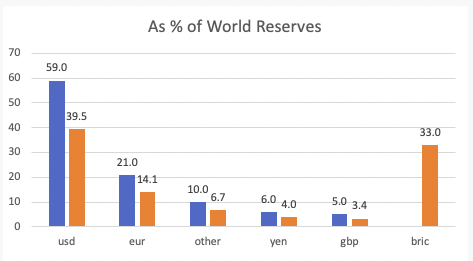
​  ​According to Pilkington, were this BRICS currency to emerge – and western leaders’ actions make it likely sooner rather than later – we can expect roughly a 33 percent devaluation of the western currencies… something which would result in what can only be described as hyper-stagflation, with prices of imports – including essentials like food and fuel – rising beyond the reach of all but the wealthiest westerners, even as that mountain of unrepayable debt comes tumbling down so rapidly that it will render most of what we still consider repayable bad as well.

​  Sergey Glazyev is a Russian economist with the kind of clear nderstanding of currency flows that Michael Hudson has and John Maynard Keynes had. He has long been frustrated that the Russian central bank comports itself in the same manner as western central banks. if his advice had been taken, Russia would not have had $300 billion of national assets frozen. He is the cheif economist working out the BRICS currency.​ Pepe Escobar interviewed him recently.
​  ​What Glazyev repeatedly emphasized is that as long as there’s no reform of the Russian Central Bank, any serious discussion about a new Global South-adopted currency faces insurmountable odds. The Chinese, heavily interlinked with the global financial system, may start having new ideas now that Xi Jinping, on the record, and unprecedentedly, has defined the US-provoked Hybrid War against China for what it is, and has named names: it’s an American operation.
​  ​What seems to be crystal clear is that the path toward a new financial system designed essentially by Russia-China, and adopted by vast swathes of the Global South, will remain long, rocky, and extremely challenging. The discussions inside the EAEU and with the Chinese may extrapolate to the SCO and even towards BRICS+. But all will depend on political will and political capital jointly deployed by the Russia-China strategic partnership.
​  ​That’s why Xi’s visit to Moscow next week is so crucial. The leadership of both Moscow and Beijing, in sync, now seems to be fully aware of the two-front Hybrid War deployed by Washington.
​  ​This means their peer competitor strategic partnership – the ultimate anathema for the US-led Empire – can only prosper if they jointly deploy a complete set of measures: from instances of soft power to deepening trade and commerce in their own currencies, a basket of currencies, and a new reserve currency that is not hostage to the Bretton Woods system legitimizing western finance capitalism.
https://thecradle.co/article-view/22457/interviews

  Greek War News site says Russia has located the MQ9 Reaper drone at the bottom of the Black Sea with underwater drones and has positioned a specialized ship above it to recover it. The US has released a video clip of Russian Su 27 fighter(s) making 2 runs and dumping jet fuel, which caused propeller damage after the second run, though the drone camera footage shown did not show the drone to be grossly unstable at that point. 
  The Pentagon has claimed that a Russian fighter clipped the propeller  with a wingtip, which Russia specifically denies. 
It is likely that Russian pilots were trying to get the drone to turn around, to stop flying towards Crimea. 
The $65 million Reaper drone happens to have fallen very close to Russia's South Stream pipeline.

​  ​The hidden security clauses of the Iran-Saudi deal

  Although the Beijing statement primarily addresses issues related to diplomatic rapprochement, Iranian-Saudi understandings appear to have been brokered mainly around security imperatives. Supporters of each side will likely claim their country fared better in the agreement, but a deeper look shows a healthy balance in the deal terms, with each party receiving assurances that the other will not tamper with its security.
  While Iran has never declared a desire to undermine Saudi Arabia’s security, some of its regional allies have made no secret of their intentions in this regard. In addition, MbS has publicly declared his intention to take the fight inside Iran, which Saudi intelligence services have been doing in recent years, specifically by supporting and financing armed dissident and separatist organizations that Iran classifies as terrorist groups.
  The security priorities of this agreement should have been easy to spot in Beijing last week. After all, the deal was struck between the National Security Councils of Saudi Arabia and Iran, and included the participation of intelligence services from both countries. Present in the Iranian delegation were officers from Iran’s Ministry of Intelligence and from the intelligence arms of the Islamic Revolutionary Guard Corps (IRGC).
  On a slightly separate note related to regional security — but not part of the Beijing Agreement — sources involved in negotiations confirmed to The Cradle that, during talks, the Saudi delegation stressed Riyadh’s commitment to the 2002 Arab peace initiative; refusing normalization with Tel Aviv before the establishment of an independent Palestinian state, with Jerusalem as its capital.                                                                                                                     What is perhaps most remarkable, and illustrates the determination by the parties to strike a deal without the influence of spoilers, is that Iranian and Saudi intelligence delegations met in the Chinese capital for five days without Israeli intel being aware of the fact. It is perhaps yet another testament that China — unlike the US — understands how to get a deal done in these shifting times.
         
https://thecradle.co/article-view/22445/exclusive-the-hidden-security-clauses-of-the-iran-saudi-deal

  Moscow rolls out the red carpet for Syrian President Basher al Assad
  The statement also noted that Wednesday is the "anniversary of the conflict" which started 12 years ago in March 2011. Assad emerged victorious especially with Russia's help, given the the Russian military intervention at the invitation of the Syrian leader in 2015... 
  According to details of Assad's red carpet arrival in Moscow:
Assad was received by Putin’s special representative for the Middle East, Mikhail Bogdanov, at Moscow’s Vnukovo international airport.
Prior to a deadly Feb. 6 earthquake that killed 50,000 people in Turkey and Syria, Russia had been mediating talks between the two quake-hit countries.
  Turkish representatives are expected to be present for events related to Assad's visit, with The Associated Press detailing that "The Syrian, Turkish and Russian deputy foreign ministers as well as a senior adviser to their Iranian counterpart are also set to hold talks Wednesday and Thursday in Moscow to discuss 'counterterrorism efforts' in Syria."  
   Given Assad and the Syrian Army have emerged victorious after over a decade of fighting, which also on multiple occasions saw the US bomb government-held cities and areas, including the capital, even Turkey appears to be warming to the idea of rapprochement. Both sides want US troops out of northeast Syria as well. President Erdogan has in particular bristled at Washington's training and support given to Syrian Kurdish groups aligned with the outlawed PKK.

  After Mideast (West Asian) leaders meeting this week, Putin and Xi will make some joint announcement next week in Moscow. China seeks to maintain good relations with both Russia and Ukraine. Xi will speak to Zelensky remotely after meeting with Putin. China can offer a lot of carrot to Ukraine, not just stick.  Ukraine is pivotal to pan-Eurasian "New Silk Road" trade, which China is very much promoting.

​  German Minister of Health, Karl Lauterbach has hedged his official position in an interview.
  ​In 2021 he claimed in a Tweet that COVID-19 ‘vaccines’ had no side-effects. Remarkably, his current admission is, “That was an exaggeration that I once made in an ill-considered Tweet. It did not represent my true position.“! It is egregious that a federal Minister of Health is admitting this AFTER coercing most people to get the shots and claiming everyone gave fully informed consent. After a desperate attempt to backpedal, all while looking incredibly uncomfortable, Lauterbach was called out by the interviewer for repeatedly promoting his message that the shots were “more or less free of side-effects”.
​  ​The interviewer to Lauterbach:
“So, you’ve always given the impression that side-effects aren’t really a thing.“
​  ​With respect to severe COVID-19 ‘vaccine’-induced injuries, Lauterbach stated:
“I’ve always been aware of the numbers. They have re​main​ed relatively stable. …1:10,000: some may say that’s a lot, and some may say it’s not that much.“

​  This report is all that I can find about the February 22 crash of an airplane at Clinton Airport in Arkansas, with a crew of chemical analysis experts headed to Ohio.​
​  ​This third part in an investigative series on the Ohio train derailing examines the mysterious plane crash in Little Rock, Arkansas, that killed five employees with the environmental laboratory contracted by Norfolk Southern for field studies of the chemical residues left from the EPA-ordered burn-trench disposal at East Palestine. The highly suspicious downing of a Beechcraft twin-prop plane, owned and operated by the Center for Toxicology and Environmental Health (CTEH), which has been revamped with a bright young team following its 2002 takeover by Irvine-based Montrose from the founding toxicologist, who had been widely criticized for laxity in favoring corporate polluters.
​  ​Despite exaggerated local media reports of strong winds at noon on Wednesday, February 22, the weather conditions posed no threat to flying, which raises serious questions of why the company-owned plane crashed within a minute of clearing Runway 18 at the Bill and Hillary Clinton National Airport. The irregularities surrounding the air-crash included an official cover-up of the actual crash location inside a 3M industrial complex, suspension of phone reception at Little Rock 911 and blatant disinformation by the Gannett newspaper group on the ill-fated Beechcraft’s destination.
​  ​Thus far, a review of that midair blast along with the registered flight destination suggests that the CTEH team was targeted for elimination under the pervasive Biden cover-up of chemical warfare agents in the tanker cars destined for secret use in Ukraine, which instead derailed at East Palestine, Ohio. Crashing a short distance from takeoff, the Beech BE20, an upgraded Beechcraft 200 Super King Air, which has an excellent reputation for flight performance and air safety, was blown to shreds midair before its fiery nose-dive into a 3M factory warehouse on the north end of the complex, barely averting a highway pile-up on Route 440, the link road between I-40 and I-30.​..​
​..​Just prior to noon on Wednesday, February 22, toxic site inspectors Micah Kendrick, Kyle Bennett, Gunter Beaty, and Glenmarkus Walker boarded the CTEH-owned twin-engine Beech BE20 (a 9-passenger business version of a Beechcraft 200 Super King Air) at the Bill and Hillary Clinton National Airport in Little Rock, Arkansas. Earlier predictions of light rainfall had not materialized and winds from the southwest were subsiding to below 40 mph. On takeoff from Runway 18, which is reserved for small aircraft, pilot Sean Sweeney planned to keep the plane climbing toward the south, into the wind, with the aim of circling leftward over the Arkansas River onto a northeasterly flight path toward Ohio with the added advantage of a tailwind. All systems were go, there was no cause for concern at takeoff.
​  ​After clearing the runway, at the start of ascent along a straight line and immediately after crossing the Highway 40 bypass (which connects I-40 with I-30), less than a mile from takeoff, the BE20 was suddenly blown to bits by a powerful explosion. The fragmenting plane nose-dived toward the rear of the 3M industrial complex, crashing through the roof of a large warehouse with truck-loading docks. A pillar of black smoke from burning aircraft fuel rose into the gray sky, and was caught on video by a nearby weather helicopter.
 The steep fast dive allowed no time for a bail-out by the passengers or pilot, who were likely killed in the powerful blast or within a few seconds after being crushed on impact. 
​  ​Phone calls to 911 went unanswered over the next hour.
​  ​Meanwhile, as an emergency crew closed off the 3M grounds and hosed the flames, another team from an as-yet identified agency set up a fake crash-site farther south in a junkyard, hauling pieces of wreckage to that decoy site for reporters to snapsho​o​t.


​  Forests draw water towards themselves in atmospheric flows, and it drops on them. 
This is described here, with link to scholarly paper. Thanks Ugo Bardi.​
​  ​The Forest: a Holobiont that Creates Rain

​Rain Man (pictured sealing the covered decking after sealing all the uncovered decking before the rain)​  


Tuesday, March 14, 2023

Money Is Political

 Political Economists,


  Dr. Tim Morgan, Surplus Energy Economics, The Everything Crisis looks at where we now are, in a global economy in absolute decline because the percent of the economy that now has to be spent getting energy sources like oil and gas, is now such a heavy economic price that economies are shrinking in real terms. the ECoE, energy cost of Energy is like an everything tax. There is no truthful economic framework to explain this, so excuses like COVID-lockdowns, War and Russian-sanctions.
​  ​Global trend ECoE (from all sources of primary energy) has risen from 2.0% in 1980 to almost 10% now, and is likely to reach 13% by 2030, and 17% by 2040. What this means is that, from every 100 units of accessed energy, the ‘available for use’ or surplus component has decreased from 98 units in 1980 to 90 units now, and is likely to have fallen to 83 units by 2040.
​  ​It’s important to remember that surplus energy isn’t used just to supply products and services to consumers, but to maintain and replace productive and social infrastructure as well. This means that sensitivity to rising ECoEs is an inverse function of complexity – the more complex an economy is, the greater is the surplus energy required just to sustain the system.
​  ​Complexity is highest in the Advanced Economies of the West which has meant, in practice, that prior economic growth in these countries went into reverse first, happening once their ECoEs reached about 5%, a climacteric which was traversed in the early 2000s. EM (emerging market) economies, by virtue of their lesser complexity, have been able to carry on expanding at ECoEs above 5%, but most of these countries have now hit their own inflexion-points, which occur at ECoEs of around 10%.
​  ​Accordingly, global prosperity per capita peaked in 2019, and preliminary data indicates that world aggregate prosperity may have peaked in 2022.

​  A snippet from Michael Hudson from the presentation he did with Radhika Desai about financial imperialism, and alternatives. "Since Money Is Political" is the first part coming second. Forgive me. 
  What is money, and how is it used? Hudson mentions this option, which the US did before WW-2, and Japan did, and China and South Korea have done, and Germany did under Bismark and much of the time since... (and the Bank of North Dakota still does.)
​  What you say, about finance living in the short run, is very important. There was an alternative and I have a chapter about that in my Killing the Host. And the alternative was Germany and central banks. The banks worked with the government and heavy industry to take a long term view of the economy. And this isn’t something abstract.
​  ​When WWI broke out in 1914, there were articles written in the British press about why Britain was likely to lose the war, and it was likely to lose because they said, “Our financial system is quasi-feudal. It lives in the short run. When a stockbroker in England buys stock, they want to use the company to pay out all of its income and dividends. They don’t want the company to reinvest. They want to make the stockholders rich by paying out dividends and stock buybacks.”
​  ​The Germans, with the government, use their dividends to reinvest in capital formation, and they said that because of the Reichsbank in Germany and other Central European practices, it’s likely that Germany and its allies are going to be able to outlast England because English finance is self-destructive.
​  ​The difference you’re talking about is between industrial capitalism and the old feudal finance capitalism. But after WWI, it turned out that instead of having the productive, socialized German system, you had finance capitalism or neo-feudal money under the direction of the United States, which has always followed the British system, short term, hit-and-run, grab. The more you can impoverish the debtor, the more money you have in your own hand — as opposed to public banking.
​  ​This is all important, as is money and credit. We’re back to: Is it going to be a public utility run in the public interest by governments, or is it going to be run by bankers (whose objective is to impoverish the economy in order to enrich themselves)?
https://michael-hudson.com/2023/02/since-money-is-political/

​  Simon Black writes, "If SVB is Insolvent,So Is Everybody Else"​, then he proves it. In 2008, junk mortgage backed securities were the toxic paper that forced banks into massive losses; now it is US Treasury debt, at low long-term interest rates, which is losing value precipitously as interest rates rise.  The Fed holds a lot of it. All of the banks that hold it are either insolvent, or nearly insolvent now. Silicon Valley Bank was audited in January. It was exemplary.

  Michel Hudson, Why The Banking System Is Breaking Up  [Well, not quite yet, I think.]
..Interest rates, which spiked last Thursday and Friday to close at 4.60 percent for the U.S. Treasury’s two-year bonds. Bank depositors meanwhile were still being paid only 0.2 percent on their deposits. That has led to a steady withdrawal of funds from banks – and a corresponding decline in commercial bank balances with the Federal Reserve.
 Most media reports reflect a prayer that the bank runs will be localized, as if there is no context or environmental cause. There is general embarrassment to explain how the breakup of banks that is now gaining momentum is the result of the way that the Obama Administration bailed out the banks in 2008 with fifteen years of Quantitative Easing to re-inflate prices for packaged bank mortgages – and with them, housing prices, along with stock and bond prices.
  The Fed’s $9 trillion of QE (not counted as part of the budget deficit) fueled an asset-price inflation that made trillions of dollars for holders of financial assets – the One Percent with a generous spillover effect for the remaining members of the top Ten Percent. The cost of home ownership soared by capitalizing mortgages at falling interest rates into more highly debt-leveraged property...
 ..But in serving the banks and the financial ownership class, the Fed painted itself into a corner: What would happen if and when interest rates finally rose?
  In Killing the Host I wrote about what seemed obvious enough. Rising interest rates cause the prices of bonds already issued to fall – along with real estate and stock prices. That is what has been happening under the Fed’s fight against “inflation,” its euphemism for opposing rising employment and wage levels. Prices are plunging for bonds, and also for the capitalized value of packaged mortgages and other securities in which banks hold their assets on their balance sheet to back their deposits...
..Any bank has a problem of keeping its asset valuations higher than its deposit liabilities. When the Fed raises interest rates sharply enough to crash bond prices, the banking system’s asset structure weakens. That is the corner into which the Fed has painted the economy by QE.
  The Fed recognizes this inherent problem, of course. That is why it avoided raising interest rates for so long – until the wage-earning bottom 99 Percent began to benefit by the recovery in employment. When wages began to recover, the Fed could not resist fighting the usual class war against labor. But in doing so, its policy has turned into a war against the banking system as well...
..There is an even larger elephant in the room: derivatives. Volatility increased last Thursday and Friday. The turmoil has reached vast magnitudes beyond what characterized the 2008 crash of AIG and other speculators. Today, JP Morgan Chase and other New York banks have tens of trillions of dollar valuations of derivatives – casino bets on which way interest rates, bond prices, stock prices and other measures will change.
  For every winning guess, there is a loser. When trillions of dollars are bet, some bank trader is bound to wind up with a loss that can easily wipe out the bank’s entire net equity.
  There is now a flight to “cash,” to a safe haven – something even better than cash: U.S. Treasury securities. Despite the talk of Republicans refusing to raise the debt ceiling, the Treasury can always print the money to pay its bondholders. It looks like the Treasury will become the new depository of choice for those who have the financial resources. Bank deposits will fall. And with them, bank holdings of reserves at the Fed.
  So far, the stock market has resisted following the plunge in bond prices. My guess is that we will now see the Great Unwinding of the great Fictitious Capital boom of 2008-2015.

​  ​The Federal Reserve Launches Program to Bail Out Banks
​  ​On Sunday, the FDIC created “bridge banks” to handle both insured and uninsured customer deposits. Banking regulators assured depositors that they would have full access to all of their funds.
​  ​Meanwhile, the Federal Reserve announced a loan program that will allow other banks to easily access capital “to help assure banks have the ability to meet the needs of all their depositors.”
​  ​The Bank Term Funding Program (BTFP) will offer loans of up to one year in length to banks, savings associations, credit unions, and other eligible depository institutions pledging US Treasuries, agency debt and mortgage-backed securities, and other qualifying assets as collateral. Banks will be able to borrow against their assets “at par” (face value).
​  ​According to a Federal Reserve statement, “the BTFP will be an additional source of liquidity against high-quality securities, eliminating an institution’s need to quickly sell those securities in times of stress.”
​  ​The US Treasury will provide $25 billion in credit protection to the Fed from the Exchange Stabilization Fund...
 ..As interest rates rise, bond prices fall. With interest rates rising so quickly, banks have not been able to adjust their bond holdings. As a result, many banks have become undercapitalized on paper. The banking sector was buried under some $620 billion in unrealized losses on securities at the end of last year, according to the Federal Deposit Insurance Corp.
​  ​The BTFP gives banks a way out, or at least the opportunity to kick the can down the road for a year. Instead of selling bonds that have dropped in value at a big loss, banks can go to the Fed and borrow money at the bonds’ face value.
​  ​In effect, the Fed will print money out of thin air to loan to banks. This is the very definition of inflation.
​  ​Also, the Fed is putting its thumb on the bond market by incentivizing banks and other institutions to hold Treasuries instead of selling them into the market. In effect, it creates an artificial limit on the supply of Treasuries, which will artificially keep prices higher than they otherwise would be...
..The plan creates a mechanism for banks to acquire capital they couldn’t otherwise access under normal market conditions. Meanwhile, uninsured depositors will get their money back.
​  ​The government can plausibly claim it is not bailing out SVB or Signature Bank. Both institutions appear to be doomed. But the government is bailing out uninsured depositors and it is setting the stage to bail out other banks that would have suffered the same fate without the loan program...

​  These articles present an economic picture where notional economy and real economy a badly mismatched, and the assumptions about future economy are based on growth, when it must actually continue to contract. This contraction has to spare the necessities, so it must take place in non-necessities, "discretionary spending". 
  Debts are based on the assumption that the economy will grow in the future, so debts are much greater than the real economy, and that reality-gap is growing.
For an economy to work best, the reality of the physical economy should be reflected in the structure and assumptions of the notional economy, represented by money. A debt is an asset, and equivalent to money in the current system. A lot of the stock market gains mentioned above, fed by money at low or effectively-negative interest rates since 2008, do not correspond to company value or dividend payment. They have just been bid-up. Reducing these valuations is possibly the easiest way to bring more realism into the correlations between notional wealth and physical wealth.​ 
  General price inflation, reducing the notional value of money/debt, also brings the notional economic representation closer to the physical wealth in existence. House prices may not fall much, but the dollars will be worth less, a replay of the stagflation of the 1970s and early 1980s, which was a similar adjustment phase.
  A big challenge is to keep a functioning financial system, so that the real economy can keep working, because if it fails, then society has lost its life support system. Nothing would have trade-value beyond a bag of potatoes, water and a propane tank. Cannibalism was widespread in Ukraine during the famine called the "Holodomor". Families ate family members bodies. Parents ate their dead children. Stalin needed money for tank factories and sold too much of Ukraine's grain. The hate engendered drove Western Ukraine, Galicia, into an alliance with the Nazis. 
  As financial losses and monetary inflation bring the notional economy of money closer in valuation to the physical wealth in existence, ownership is critically important. There are easy levers to pull to protect bank-ownership, and to protect bank deposits, though they create money to place into some specific gaps, which is inflationary, difffusing losses to everybody who spends money. 
  When people can't keep up payments on a mortgage, the lienholder takes the whole house, even if it is 90% paid-off. Is that fair? The rich get richer, and the middle class gets poor. How might something like that be arbitrated. The Obama administration said they would help the homeowners, but actually wiped them out and gave their houses to Wells Fargo, instead. Everybody knows that now. Assignement of economc losses will need to be open and fair to maintain a social contract through hard times. The gap between rich and poor is already greater than at any time in US history. Creating an Americn Holodomor would be a gross error. Assignment of most losses of real wealth to the wealthiest could preserve function in American society. How will that be approached and managed, or even discussed, after the banking and equity-market losses are assigned? Roosevelt managed such a task. There were 3 assassination attempts on him, wherein several other people were killed, before he was inaugurated. Then came the "businessman's coup" that USMC ret. General Smedley Butler revealed.
  Countries run by oligarchies, as the US is, still need a powerful executive to act independently in times of rapid and critical economic change. The US oligarchs have not been willing to give up their decision-making power so far, and have held to the failed unipolar-world model within the $US and Eurodollar global financial system. Russia, China, Turkey, India, Saudi Arabia and Iran all have such executives now....
  We can see a lot of systemic blame being tallied-up now, which will be placed on the outgoing political administration, not on the oligarchic "owners", who they serve. The very big question is whether a real executive will be allowed into the office of POTUS, which JFK  was,  until various oligarchs had him eliminated. After WW-2 was all but over, FDR, having had Truman forced upon him as running-mate, against his will and better judgement, died-suddenly. Stalin was sure that he had been poisoned by "Churchill's gang", who certainly had the means and motive to maintain their empire, or maybe just graft its head from the City of London to New York City. We can see that potential real-executives for POTUS 2024 include Donald Trump, Ron DeSantis, and potentially RFK Jr. , who is in discussions about a presdential run. It would need to be a "different" Democratic Party to allow him to run. Kennedy is much more independent than Bernie Sanders, and Sanders was fraudulently kept from the Democratic nomination twice. Kennedy knows the stakes. He could follow his father and uncle (& maybe cousin John Jr.).

​  ​Jan. 6 Attorney Alleges FBI Criminally Altered Evidence, Requests Special Master Review Of Leaked Messages
https://www.zerohedge.com/political/jan-6-attorney-alleges-fbi-criminally-altered-evidence-requests-special-master-review

  In a country run by bankers: 10,000 Dutch Farmers Protest Govt's Crippling Nitrogen Emissions Target In The Hague
Protesters claim the Dutch government is lying about the extent of the emissions problem in order to grab privately owned land...

​  Xi Jinping will go to Moscow to meet with Vladimir Putin, presumably to announce something together. The exact date remains secret, so maybe they await an ideal geopolitical moment to make an announcement. Xi will teleconference with Zelinsky after meeting with Putin. I suspect that Putin and Xi can make Zelinsky/Ukraine a much better deal than Washington/NATO can, going into the rest of this decade, but this might not yet be the moment for that.

Ukrainian Official: 'We Don't Have The Resources For Counteroffensive'​  
​https://www.zerohedge.com/geopolitical/ukrainian-official-we-dont-have-resources-counteroffensive

China's Prestigious Middle East Deal May Soon See Challenges, Moon of Alabama
​  ​[C]onfidential clauses were inserted into the Beijing Agreement to assure Iran and Saudi Arabia that their security imperatives would be met. Some of these details were provided to The Cradle, courtesy of a source involved in the negotiations:
​ ​ Both Saudi Arabia and the Islamic Republic of Iran undertake not to engage in any activity that destabilizes either state, at the security, military or media levels.
​  ​Saudi Arabia pledges not to fund media outlets that seek to destabilize Iran, such as Iran International.
​  ​Saudi Arabia pledges not to fund organizations designated as terrorists by Iran, such as the People’s Mojahedin Organization (MEK), Kurdish groups based in Iraq, or militants operating out of Pakistan.
​  ​Iran pledges to ensure that its allied organizations do not violate Saudi territory from inside Iraqi territory. During negotiations, there were discussions about the targeting of Aramco facilities in Saudi Arabia in September 2019, and Iran’s guarantee that an allied organization would not carry out a similar strike from Iraqi lands.
​  ​Saudi Arabia and Iran will seek to exert all possible efforts to resolve conflicts in the region, particularly the conflict in Yemen, in order to secure a political solution that secures lasting peace in that country.
​  ​According to sources involved in the Beijing negotiations, no details on Yemen’s conflict were agreed upon as there has already been significant progress achieved in direct talks between Riyadh and Yemen’s Ansarallah resistance movement in January. These have led to major understandings between the two warring states, which the US and UAE have furiously sought to undermine in order to prevent a resolution of the Yemen war.
​  ​In Beijing however, the Iranian and Saudis agreed to help advance the decisions already reached between Riyadh and Sanaa, and build upon these to end the seven-year war.​..
..The U.S. does not like the deal because it diminishes its role in the region. Israel does not like the deal because it lessens its chances to go  after Iran:
​  ​The U.S. and Israel don’t look kindly on the news of the diplomatic breakthrough. They first fear that China is increasingly assertive in its role in the region, and the U.S. does
 not want to experience what Britain experienced in Suez in 1956: a watershed moment signaling its global decline. The U.S. stood up to Britain, France and Israel who combined to attack Egypt after its leader Gamal Abdel Nasser nationalized the Suez Canal. The event is seen as the final act of the British Empire before joining the more powerful U.S. imperium.
...If the agreement does accomplish the goal of truly bringing peace and amity between the two rivals, China may then enjoy a Suez moment: when the world signals the end of the American Empire like what happened to the British.
​  ​Both, Israel and the U.S, are capable and likely willing to do whatever is necessary to prevent an implementation of the deal. They can probable use their good relations with the United Arab Emirates to make things difficult. False flag attacks in Iran and in Saudi Arabia could be a way to do that. If a new 'Iranian' drone attack happens in Saudi oil fields or new 'Saudi financed' terrorist attack in Iran happen the deal could indeed be scraped.
​  ​One hopes that China and the other parties involved in the deal are conscious of that.

​  ​Israeli officials are expressing dismay at the Iran and Saudi Arabia peace deal which was announced from Beijing last Friday, with an aide to Prime Minister Benjamin Netanyahu telling reporters that it's the result of American "weakness" as well as failings of the prior Israeli government.
​  ​"There was a feeling of US and Israeli weakness and this is why the Saudis started looking for new avenues. It was clear that this was going to happen," the unnamed senior official said while traveling in Netanyahu's entourage in Rome.

​  Flyboys will be flyboys...
​  ​'Reckless' Intercept By Russian Jets Caused US Drone Crash In Black Sea: Pentagon
​  ​The US military statement of events, blaming a pair of Russian fighter jets for "reckless" maneuvers which resulted in the MQ-9 drone being struck and crashing in international waters at a "complete loss":
​  ​Two Russian Su-27 aircraft conducted an unsafe and unprofessional intercept with a U.S. Air Force Intelligence, Surveillance, and Reconnaissance unmanned MQ-9 aircraft that was operating within international airspace over the Black Sea today.
​  ​At approximately 7:03 AM (CET), one of the Russian Su-27 aircraft struck the propeller of the MQ-9, causing U.S. forces to have to bring the MQ-9 down in international waters. Several times before the collision, the Su-27s dumped fuel on and flew in front of the MQ-9 in a reckless, environmentally unsound and unprofessional manner. This incident demonstrates a lack of competence in addition to being unsafe and unprofessional.​  
("Lack" of competence?)
​  ​“Our MQ-9 aircraft was conducting routine operations in international airspace when it was intercepted and hit by a Russian aircraft, resulting in a crash and complete loss of the MQ-9,” said U.S. Air Force Gen. James B. Hecker, commander, U.S. Air Forces Europe and Air Forces Africa. “In fact, this unsafe and unprofessional act by the Russians nearly caused both aircraft to crash.”​   
(​S​o "mission-accomplished", right?)
​  ​“U.S. and Allied aircraft will continue to operate in international airspace and we call on the Russians to conduct themselves professionally and safely,” Hecker added.

​  ​The doctor indicted for not killing his patients​   I sure ​e​mpathize.
​  ​Seventy-five years ago, it was established at the Nuremberg trial for doctors that never again would we allow medical experimentation upon human beings without their consent... Meanwhile, a doctor who took his Hippocratic Oath seriously and allegedly saved nearly 2,000 patients (with FULL CONSENT) from the shots, is facing serious federal charges for conspiracy to defraud the government defrauders...
​  ​In January, Dr. Kirk Moore, along with two members of his clinic’s staff and a neighbor, were indicted on conspiracy to defraud the federal government by allegedly offering nearly 2,000 patients saline injections along with vaccine documentation while disposing of the real shots into the sink. To be clear, he is not being accused of tricking patients. He never offered unsuspecting patients fake shots. These were all people (or parents of minors) who desperately sought him out to bypass the genocidal, unconstitutional, inhumane, and immoral jab mandates, so they could go on with their lives unharmed by this terrible technology...
..According to the AMA Medical Code, “When physicians believe a law violates ethical values or is unjust, they should work to change in law.” However, it adds that “in exceptional circumstances of unjust laws, ethical responsibilities should supersede legal duties.​" ​That is clearly going to be part of Moore’s defense if he is indeed shown to have given people saline at their request.
​  ​Ironically, Moore is being accused of grifting and running a fake vaccine card ring and earning $98,000 off it. Dr. Moore, though, rigorously disputed this fact in an interview on my podcast and notes that when people asked him for his fee for COVID treatment, he told them to donate it to a 501(c)(3) medical freedom group.

​Treasures in Heaven (took this picture of Jenny with blooming pear tree​)


Sunday, March 12, 2023

The Real Deal

 Dubious,


  Michael Hudson and Radhika Desai: No Room For Gunboats, a history of the Imperial Sterling System, and how it was changed when the $US moved-in.
  There is quite a lot of explanation of the economic events from WW-1 through the end of 1949, which is as well-presented as I have ever seen, then this:
  Everybody was complaining by 1950. The United States solved the problem in a way that nobody had expected. The Korean War — from the time America entered the Korean War in 1950/51, every single year its balance of payments moved into chronic deficit that got deeper and deeper until 1971 when it was forced off gold.
  The entire balance of payments deficit was equal to, year after year, to America’s military spending abroad.
  When I left Chase Manhattan Bank, I was employed by Arthur Anderson to do an analysis of the US balance of payments. I produced the charts and the statistics — they are repeated in Super Imperialism — to show the entire deficit was indeed U.S. foreign military spending.
  At that time, Mr. John McNamara, the Secretary of Defense, telephoned Arthur Anderson and said, if they supply [Michael’s] report, [Arthur Anderson] would never get another contract with the US government.
  So my boss Mr. Barsanti came in and apologized to me and said that they couldn’t publish it.
  Their art department had made very nice charts and he gave them to me. And I went to New York University’s business school and I published it,  all these statistics, and a monograph summarized in Super Imperialism.
  The Federal Reserve, then, thought, “How are we going to cope with this?”

  They didn’t want to attack me obviously, so they attacked all the publications of NYU’s business school. They said that the fact that I found the Vietnam War responsible for the deficit and military spending doesn’t give confidence in NYU’s editorial decision.
  But then one of my students, at The New School where I was teaching international finance and trade, worked for the Federal Reserve and showed me their internal memos saying, “Yes this is true, we can’t let it get out.”
  All of this discussion about international balance and fairness, as if all the balance of payments deficits were international trade, ignored two things.
  They ignored, number one, military spending that was the key to the deficit, and that actually has been since the thirteenth century. War forces countries into deficit. War forces countries to borrow. That was why the Catholic Church, the papacy in the thirteenth century, legitimized interest-bearing debt to finance the wars — the crusades and the wars it was fighting.
  So this is a constant throughout history. It doesn’t appear in any of the “free trade” economic models. It’s as if governments don’t exist.
  And the other thing that doesn’t exist in this, saying that balance of payments equilibrium is all trade — they then say that all trade is a result of labor asking for [higher] wages. And the way to run a deficit is to institute a class war against labor. You want to fight the labor unions, you want to lower wage levels to enable countries to have achieved balance.
  Well what they mean by “balance” is obviously to finance this US-centered, military order, because the dollars that countries who are accumulating — when they weren’t asking for gold — were loans to the US Treasury by buying Treasury Bills that financed not only the domestic budget deficit — that was largely military — but also the balance of payments deficit.
  So the entire stability between 1951 and 1971, for 20 years, was provided by military spending as the United States put military bases all over the rest of the world.
  So what achieved balance was military — the military deficit. Not trade adjustment. Not investment adjustment. All of this is left out.
  Trade theory does not have room for the gunboats. And if you look at the balance of payments for the last 800 years, it’s all about the gunboats. That’s the amazing thing.
  And what we’re focusing on is the politics. International exchange rates and relations are not a function of “free market” arrangements. They are a function of intergovernmental debt — not so much private [debt] — and military spending. And governments paying their foreign currency by selling off their infrastructure.
  I want to make one final comment. When Radhika says that “stability is achieved by investing,” I said that was the US nightmare.
  That nightmare was imposed — the iron hand was the World Bank. There is a reason it’s usually led by defense department and military heads. The prime directive of the World Bank is, “No country should compete with major products that the United States exports — above all, grain.
  The one thing that the World Bank has opposed is other countries growing their own food grain.                            

"Never Seen In Over 40 Years" - SVB Collapse Sparks Bank Runs As People Wait In Lines

Yellen Says Government Will Help SVB Depositors But "No Bailout" As Fed, FDIC "Hope" Talk Of Special Vehicle Prevents More Bank Runs
(There is good analysis in this article of how SVB had forced risk onto customers by making those businesses that took loans from SVB, tech start-ups, etc. do all of their banking at SVB, ​assuming a lot of risk​ from SVB​, for only a small premium. The bank got-over on them, they are​ now​ the hostages.)

​  They can only regret the widespread bank-run that will be brought on by failing to secure deposits.​
​  ​SVB Latest Developments Live Blog: Regulators Weighing Bailout Of All Unsecured Depositors To Prevent "Banking Panic"
3:00pm ET Update: In a reversal of what Janet Yellen said just hours ago, WaPo reports that federal authorities are "seriously considering safeguarding all uninsured deposits at Silicon Valley Bank" - and by extension any other bank on the verge of failure - and are weighing an extraordinary intervention to prevent what they fear would be a panic in the U.S. financial system. Translation: bailout of all depositors, not just those guaranteed by the the FDIC.
4:30pm ET Update:  It's getting to the point where every new "proposal" or "idea" being thrown about is worse than the previous one​..​​. Shortly after the WaPo reported that the Fed is "seriously considering safeguarding all uninsured deposits at Silicon Valley Bank", BBG is out with a report that the Federal Reserve is also "considering easing the terms of banks’ access to its discount window, giving firms a way to turn assets that have lost value into cash without the kind of losses that toppled SVB Financial Group."​   [This is good strategy,  in my opinion. It supports trust in ​$​US banking.]
​  ​Such a move would increase the ability of banks to keep up with demands from depositors to withdraw, without having to book losses by selling bonds and other assets that have deteriorated in value amid interest-rate increases — the dynamic that caused SVB to collapse on Friday.

"It's As Bad As We Thought": CCP Money Flowed To Biden Family According Bank Records, Documents Obtained By House GOP

​  This article from Greece can be Google translated. It makes the case that a negotiated settlement to the war in Ukraine is (secretly) coming. That will realistically involve ceding to Russia all that is already declared to be Russian territory, merely as a practical matter.​ 
  China has an interest in peace, as does Europe. The US has interests in preventing normal trade relations between Europe, Russia and China. Ukraine stands to be an important economic corridor. 
  I would like to point out what Hudson and Desai point out above, that "Ukraine" is being saddled with unpayable debt, making it malleable to western policy decisions, and subject to loss of both land and political sovereignty. Maybe Russia and China can offer "Ukraine" and Europe a better deal.

​Here is another war news article in Greek, saying that a bomb-assassination of the president of Transnistria has been prevented, and many lives saved. It reports plans to invade Transnistria from the Ukrainian and Moldovan sides simultaneously. I keep wondering how many of the hypersonic missile strikes last week hit joint Ukraine/NATO command centers, preparing for Ukraine's spring offensive (when the deep mud hardens-up). How are those secret negotiations going?

Iran reverse-engineered an American TOW antitank missile of 1970s vintage. Russia has now sent multiple Javelin anti-tank and Stinger anti-aircraft missile systems to Iran for analysis and possible reverse-engineering, or development of electronic countermeasures. Greek again.

  This analysis assumes a little too much. The US has only opened-the-option of blaming Ukraine for the Nordstream bombings; has not thrown Ukraine under the bus (yet). This puts pressure on Ukraine to accept whatever the US/NATO dictates. The Ukrainians are probably getting sick of this. Will Ukraine shift "enemies"?
Tulsi Gabbard Explains Why US Threw Ukraine Under the Bus by Blaming Kiev for Nord Stream Blasts

​  We may assume that Putin and Xi will meet in Moscow, but may not assume details. China just negotiated a rapprochement between Iran and Saudi Arabia, which means that Israel has also had to make new deals with Russia, Cina and Saudi Arabia, or is doing so.​ Whatever influence Israel may have upon US foreign policy, that is now only part of the regional equation, and may soon be even less. The US is having something like Britain's Suez Crisis moment.
  China has been speaking in a more straightforward way against American imperialistic foreign policy and double-standards. This seems to be accelerating in even the past week or two. China would probably not do this if there were any uncertainty about it backfiring. Since this is hybrid war, and finance is an important part, especially global trade finance, I suspect that China and Russia have an announcement to make about the "newcoin" global trade currency, which was detailed by Pepe Escobar, from a source nicknamed "S. Tzu", who was the author of the Taoist classic, "Art of War".  
​  ​BEIJING, March 7. /TASS/. The Chinese Foreign Ministry is unable to confirm information that Chinese President Xi Jinping will visit Russia on March 21, Chinese Foreign Ministry spokeswoman Mao Ning said on Wednesday.
​  ​"China and Russia maintain close contacts at all levels, but we have no information now about the visit you are asking about," she said curtly to a reporter at a news conference.​     ​
https://tass.com/world/1586107

​  At a moment where the bank-run has begun in the US, and the US is clearly losing, and secretly negotiating peace in Ukraine, and has been outed for blowing up Germany's gas pipelines, the stronger a joint-statement made by China and Russia​, the more decisive it will be in rapidly unseating the remaining global authority of the $US, which is the "New Sterling System", as above. Leaving behind an imperialist global trade system for something very much more like what John Mayynard Keynes proposed at Bretton Woods is discussed in that Hudson/Desai co-presentation. It is a noble objective.

When Censorship Fails: Two Thirds Of US Adults Think COVID Likely Started In A Lab

​  ​Steve Kirsch:​  ​A new study covertly released by the Israeli Ministry of Health confirms what we know from the Medicare data: the COVID vaccines increase your risk of death over time.

​  I would entitle this "Ten bold faced government lies refuted"​.
FDA and CDC Assertions in Doubling Down on COVID-19 Vaccination​  Peter McCullough MD​
Letter to Florida Surgeon General Tells America to Expect More Tension Over Injuries, Disabilities, and Deaths


​Spring Breaker (pictured in Austin kitchen-garden)


Saturday, March 11, 2023

Controlling The Channels

 Direct P​a​rticipants,

​  ​Tessa (Fights Robots) Lena, The primary goals of the internet have always been surveillance and control. Today, it is merely following its original design.
Story at a glance:
Amid attacks on the First Amendment, Missouri v. Biden could be one of the most important civil rights lawsuits of our times
While today’s obnoxious surveillance and censorship are new, they are a feature of the Internet, not a bug
Internet (originally ARPANET) was born out of a Pentagon surveillance and counterinsurgency project
It was implemented by ARPA, a DoD research agency that we know as DARPA
  Now, let’s go down the rabbit hole. To me, it’s funny and not funny to think about the interwoven Russian doll of state and corporate mob-like control — even under the best of political conditions — and certainly under the conditions we face today. You peel one layer of domination — and instead of the true freedom you were craving, you find another.
  You painstakingly peel the next one, hoping for freedom this time, but then you discover yet another layer of domination, under a different logo. It’s like when the Soviet Union finally crashed when I was a kid, and — on its ruins — the children of the communist leaders became the oligarchic leaders of the land.
  And so, in our good hearts, we hope that state authorities will protect us from excessive corporate greed, and we hope that free market will protect us from the state boot — but then we look closely, and we realize that we were born into a world run by a collection of mobs — state and corporate mobs of different kinds — and that we are very lucky citizens when we are not in the crossfires of mob wars and can go about our daily lives without being stomped.
  To me, this realistic observation was a moment of great humility and existential clarity. This is how this world is right now...
..The Internet came out of a 1960s Pentagon project called ARPANET. ARPANET was a counterinsurgency, communications, and surveillance project developed by the Advanced Research Projects Agency (ARPA) and based on the idea of “Great Intergalactic Network,” a futuristic-sounding term coined by J. C. R. Licklider, nicknamed “Lick.” Lick was an American psychologist and computer scientist and one of the “founding fathers” of interactive computing.
  We all know ARPA as DARPA, the creepy DoD agency behind the Operation Warp Speed. ARPA was originally formed in response to the shock of being “beaten” by the USSR in space after the USSR launched its Sputnik in 1957.

​  ​BREAKING - House Votes 419-0 on a Limited Hangout Bill that Requires Director of National Intelligence to Declassify All Information on the Origins of COVID. The bill now requires Biden's signature.​  
Thanks Luc, but will they look at what happened at  Ft. Detrick Md. in the summer of 20​1​9? Probably not that.

​  ​Mediated By China Iran And Saudi Arabia Restore Ties - There Are Winners And Losers
Congrats to China for nudging this deal forward and making it possible.​  ​
​  ​The winners are:
Iran, which will now be even more able to break through the sanctions wall the U.S. has put up around it.
Saudi Arabia, which now will likely be able to end its disastrous and costly war on Yemen.
China, for outplaying the U.S. State Department by achieving this.
Iraq, Syria, Yemen as they will become more peaceful as the two middle powers influencing policies on their grounds end their rivalry.
​  ​The losers are:
Israel, because the chances for its attempts to get the U.S. into a war with Iran are now diminished. Its hoped for coalition with the Saudis will not come into being.
The U.S. for having been outplayed on its traditional 'home grounds' in the Middle East.
Anti-Iran hawks everywhere.
The Emirates for losing at least some of the sanction busting trade with Iran to Saudi Arabia.

​  More about India's pivot in global trade and finance, from Tom Luongo, looking at George Soros attacking Narendra Modi for not playing the game. Thanks Eleni.​
India: The Next Front in the War on the BRICS
​  ​This brings me back to India as the wildcard. Modi’s journey from a guy with one foot on two islands (East v. West) to planting his feet firmly with the East has been an interesting and vital one.
​  ​If we’ve learned nothing else over the past year of war in Ukraine it is that most of the world is unphased by threats by the US by the countries I’ve just discussed. Iran clearly doesn’t care. China understands that if Russia falls militarily, China is next. Saudi Arabia and the rest of OPEC+ understand who their future trade partners really are.
​  ​This is why India is now in the crosshairs of Davos. They are the last major power in the region left to stymie Asian integration.
​  ​Reports circulated the same weekend as the Munich Security Conference that none other than George Soros was behind the attacks on PM Modi through a report from Hindenberg Research. They targeted one of Modi’s big financial supporters, Guatam Adani.

​  The War for the Dollar is Over, Part 2  , Tom Luongo
​  More than a decade ago I looked at the responses to President Obama cutting Iran out of the SWIFT system as the beginning of the end of the petrodollar system. The goal was to take Iran out of the global oil markets by shutting Iran out from the dominant dollar payment system.
  Out of necessity Iran opened up trade with its major export partners, most notably India, in something other than dollars. India and Iran started up a ‘goods for oil’ trade, or as Bloomberg called it at the time, “Junk for Oil.”
  The stick of sanctions created a new market for pricing Iranian oil and a way around the monopoly of US dollar oil trading. India, struggling with massive current account deficits because of their high energy import bill, welcomed the trade as a way to lessen the pressure on the rupee.
  Iran needed goods. They worked out some barter trade and the first shallow cuts into the petrodollar system were made.
  Turkey eventually joined the fray, seeing the opportunity to act as a middle man by accepting gold into its banks from Iran’s customers and settling up with Iran in dollars or whatever...

​..​Every time the US went to the sanctions well to coerce conformity, the more “star systems slipped through its fingers,” to quote Princess Leia. While we joke today about never ‘going full retard,’ this is just another way of saying that you should never threaten to nuke someone either.
​  ​Trump went sanctions nuclear on Iran in 2018. He failed.
​  ​“Biden” and Davos went nuclear on Russia in 2022, going further than even Trump. And they failed even harder.​..
​..Powell can see the de-dollarization writing on the wall and he knows now is the time to slow down that trend and find a way to make the dollar more trustworthy​..
​.​.​But ‘the help’ are no longer helpless in the face of a big bully US dollar. They have a plan and they are executing it. That plan clearly involves the return of gold as the asset to balance the trade books to rebuild global trust

​  Andrew Korybko has a follow-up article on India's diversification away from the $US in trade, particularly energy trades. Energy intermediation , refining and repackaging have been a growth industry for India in the last year. India's methods are readily applicable to other "developing countries".

​  ​Record Bank Run Drained A Quarter, Or $42BN, Of SVB's Deposits In Hours, Leaving It With Negative $1BN In Cash
​  ​Despite the bank being in sound financial condition prior to March 9, 2023, "investors and depositors reacted by initiating withdrawals of $42 billion in deposits from the Bank on March 9, 2023, causing a run on the Bank."
  ​  ​As a result of this furious drain, as of the close of business on Thursday, March 9, "the bank had a negative cash balance of approximately $958 million."  https://www.zerohedge.com/markets/record-bank-run-drained-quarter-or-42-billion-svbs-deposits-hours-leaving-it-negative-1bn 

  ​"Worst Since Lehman": Banks Break The World Again

​  ​SVB's collapse - the second biggest US bank failure in history - dominated any reaction to this morning's mixed bag from the BLS (hotter than expected earnings growth, rising unemployment (especially for Latinos), better than expected payrolls gains).
https://www.zerohedge.com/markets/worst-lehman-banks-break-world-again

​  Charles Hugh Smith has this about the Silicon Valley Bank bankruptcy.
​  Now Silicon Valley Bank has collapsed, at least in part due to doomed tech start-ups withdrawing their remaining cash to fund their last-ditch survival as the entire start-up space faces an "extinction event," as future funding from SPACs, venture capital firms and banks dries up.
  A Silicon Valley insider called me yesterday to report that the failure of SVB was very likely to trigger a severe stock market downturn, as this indicated a decline in both Financials and Tech, the two sectors that have led every Bull Market since the 1980s (and arguably, since the 1960s).
  The consensus among financial analysts holds that the Federal Reserve will quickly reverse course and drop interest rates and restart monetary stimulus (QE).  I have argued that the assumption that the Fed will once again "save the stock market" is a misreading of the situation, which is now entirely different from 2000 and 2008-09.
  I explained my rationale in What If the Whole Point Is to End "The Fed Put"? 
http://charleshughsmith.blogspot.com/2023/03/what-if-whole-point-is-to-end-fed-put.html
  In essence, the Fed must refuse to "save the stock market" to eliminate a very destructive moral hazard, i.e. stock market gamblers have been rewarded for taking hugely risky bets because they have been assured the Fed will always rescue the markets.
 
  Pepe Escobar has a piece about what a hypothetical "newcoin" for international trade would look like functionally, and what the constraints would be. 
​"​The new currency should be able to become an “external money” storage of capital and reserves down the road, not just a settlement unit.​"​
  This would be a trade currency only between participating nations, 40% backed by gold, which countries would purchase initially with their own unencumbered physical gold reserves, after allowing their own national currencies to establish a trading equilibrium with gold. 
  Following that, the "newcoin" would be backed 40% by gold and 60% by a basket of the national currencies of the participating countries, allowing those countries flexibility with their creation of currency, but having the leash that their currency would decline against the "newcoin". There could also be further draws upon their national gold reserves in some scenarios 
  This would apply gold-discipline to the trade and fiscal policies of participating countries. It would effectively be a more sophisticated and flexible gold standard, but with firm limits. The statement above implies a fixed value, that this would be a gold-like store of value, not merely a currency for transactional settlements.
  Escobar did not likely make this up. He is being given very good information, without attributing it to his sources. 
  There is a picture of Putin and Xi. They are presumably going to discuss peace talks in Ukraine next week, when they meet in Moscow. 
Will they have good news about peace? Ukraine is integral to belt-and-road trade logistics.
Will they have "newcoin" news?

  Meryl Nass MD cross posts this from David Bell, What the WHO Is Actually Proposing 
​  Briefly, there are 2 parts, a treaty "update" and new legislation for national funding of the WHO program. Both are compulsory, not voluntary, and there is no mechanism for democratic checks and balances at any level, merely compulsory compliance with technocratic decisions, expressed as mandates, which have very broad flexibility for the head technocrat. This is technocratic tyranny.​ 
  There is a percent-adoption barrier at the UN/WHO, which must be met for these to be adopted. If not specifically rejected in 6 months by a country, then it is presumed to have accepted the treaty change, and will be expected to comply financially, and when prescribed any action, such as lockdown. 
  Restrictions on free-speech opposition to mandates are specified as a condition which is expected at baseline in any  participating countries.

Preparing Your Kitchen Garden is a 21 minute video presentation by myself, provided last week to Children's Health Defense, 
as part of their Attack on Food Symposium. Food Security begins at home. 
There are links to blog posts containing all of the information discussed. 
https://live.childrenshealthdefense.org/chd-tv/events/the-attack-on-food-symposium/attack-on-food-john/
The flexible succession-rotation gardening plans are here: 

Independent Gardener (took this picture of Jenny with growing vegetables)